
-
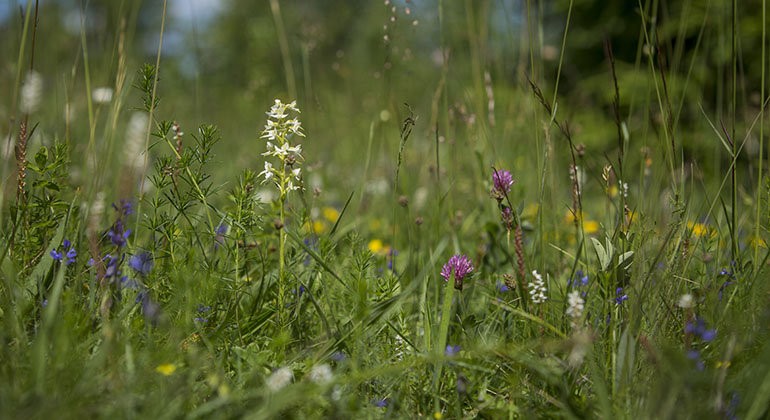
Vena hage.
Foto: Kjell store
Vena hage, Naturreservat
- Naturreservat
- Amt: Örebro län
Handlinger
Beskrivelse
The Vena hage nature reserve is located in a very old-fashioned cultural landscape in Vikersbygden near Venakärrets and Älvhytteängens nature reserve. The land has been farmed for a long time, which together with the calcareous soil has created a very rich vascular plant and fungal flora.
Species-rich pastures
The open pastures are hilly, with rocks and limestone ridges that are exposed. There are also traces of ancient stone clearing of the land in the form of clearing cairns and stone walls. Since the late 1970s, hay and silage have been harvested on the old fields, and they are now beginning to have a meadow-like, species-rich plant flora. A newly constructed pond has been in the center of the reserve since 2004.
The mining industry's need for meadows
Vena hage has been used as meadow and pasture for a very long time, probably since the Middle Ages. Maps from the 1850-60s show that the whole area was then used as hay meadows. At that time there were also some buildings in the area, a lodge and some earthworks. In the central parts of the reserve, a group of conifers is marked. At the beginning of the 20th century, the hayfield was converted to pasture. Typical of Bergslagen is that the proportion of meadowland is greater than on the farms of the plains. Mining required many draught animals and the need for winter fodder was therefore particularly great. The so-called lime farming was a common form of farming in Bergslagen, where temporary fields, lime trees, were taken up in the meadowland, and then after a few years they were laid down again and returned to meadow. It was also common for the meadows to be sparsely overgrown with trees, which were also pruned of leaves for the animals' winter feed.
Many rare fungi
Vena hage has a long tradition as meadow and pasture land. This, combined with the calcareous soil, means that it is teeming with rare, endangered and specialized species. A total of 224 species have been reported from Vena hage in the species portal, a website for those who want to report and search for animals, plants and fungi in Sweden. Of these, 22 are red-listed, i.e. species at risk of extinction in the country. There are many exciting meadow mushrooms here, such as the blue lousewort, porphyry lousewort, the common lousewort and the scarlet lousewort.
Plants and butterflies
The vascular plant flora is also rich and there are a large number of plants favored by haymaking and grazing. Some red-listed species that grow here are meadow sedge, moonflower, summer saxifrage, sand violet and haymaking. Typical of the area is also blueberry, which often grows near stone walls or stone collections. The flowering meadows are also home to many butterflies, such as the violet-edged goldfinch and the wetland butterfly.
A village with many nature reserves
In the village of Älvhyttan you will find several nature reserves. In the middle of the village is Venakärret - a so-called extreme rice bog. A little further south on the way up to Övra gården, there is an old hayfield, Älvhytteängen. On the southwest shore of Lake Älvlången you will find Näsmarkerna - a species-rich forest pasture and a little further north is another small rich marsh, namely Bromängen.
Accessibility
Vena hage belongs to level 1 in the County Administrative Board's leveling of the county's nature reserves, which means that the reserve lacks outdoor recreation facilities.
Read more about the leveling and management of protected nature
Aktiviteter og faciliteter
- Naturreservat
Fakta
Municipality: Nora
Year decided: 2017
Area: 15.6 hectares
Landowner: Individual
Reserve creator: County Administrative Board
Manager: County Administrative Board
Rutevejledning
The Vena hage nature reserve is located in Viker, 15 kilometers southwest of Nora, just east of the Venakärret nature reserve.
Regler
In the nature reserve it is forbidden to:
- drill, hack, blast, dig, carve, paint or otherwise damage rock, the earth's surface, stones or boulders, or to move or remove stones or boulders,
- drive a motorized vehicle other than on roads
- felling, removing or otherwise damaging living or dead, standing or fallen trees and bushes
- damage vegetation, for example, by picking or digging up plants such as rice, grass, herbs, mosses or lichens and fungi
- cycling except on roads and designated cycle paths
- riding horses except on roads and designated riding trails
- without the permission of the County Administrative Board, put up a permanent board, sign, poster, or similar device or to cut trails,
- without the permission of the County Administrative Board, use the area for organized competitions or exercises, camp activities or similar.
- without the permission of the County Administrative Board, carry out scientific or other studies or conduct environmental monitoring that involves marking, collection, trapping or other impact on the natural environment.
Kontakt
E-mailadresse
Organisationens logotype

Jeg har været her
Jeg vil gerne derhen
Spørgsmål og svar
Stil et spørgsmål til andre Naturkartan-brugere.
Anmeldelser
0 anmeldelser
- 5 :
- 4 :
- 3 :
- 2 :
- 1 :
Brugernes billeder
Der er endnu ingen brugerbilleder. Vær den første til at dele et!