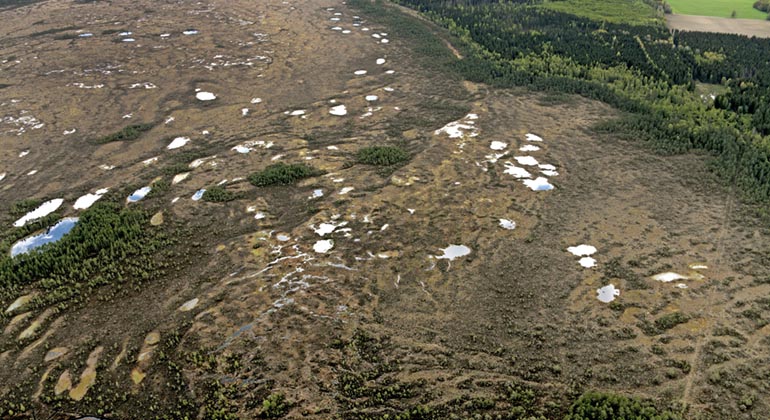
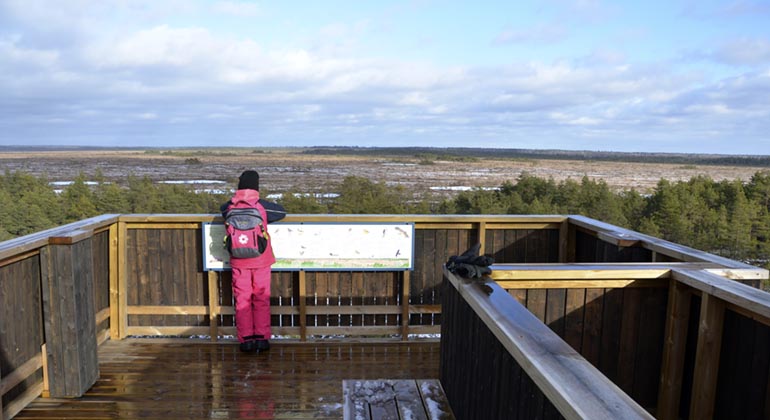
In the Skagershultsmossen nature reserve, the black grouse play in the early spring on the marsh's expanses. Later on, cranes, greenshanks and ringed plovers arrive and the air is filled with different sounds. The birdlife on the bog is rich and vibrant and is best experienced from the bird tower in the west. The bog is the largest in Örebro County and the reserve is also one of the largest in the county.
Wilderness with rich diversity
Large bogs like this are only found in northern Europe and the bogs are sometimes called "Europe's last wilderness". Few other environments can match the moors in terms of their pristine nature, even though they have sometimes been used for both moorland haymaking and peat extraction. For a time, bogs were considered 'waterlogged wastelands', unusable and worthless. Today, we see the rich diversity of plants and animals in the pristine mire and want to preserve it for the future. In the wet bog, peat is formed from moss and dead plants that have not fully decomposed due to lack of oxygen. The main ingredient in peat is various kinds of white moss. Peat is a really harsh plant environment. The layers of peat are so thick that the roots of the plants have lost contact with the groundwater. They therefore have to feed on the little nutrition that comes from above in the form of rain and snow.
Cranes, herringbills and marsh marigolds
The bog is home to a rich plant and animal life. More cranes nest here than on other bogs in the county. Many young cranes also stay over the summer. Wading birds such as the heath pipit, greenfinch, lapwing and snipe are also common on the bog. In the small pools in the north-west, near the bird tower, little grebes and teals are often fully visible. The vegetation on the bog is sparse and not particularly rich in species, but still interesting. In the nutrient-poor environment, for example, reed canary grass grows. The reed canary grass is a carnivorous plant that traps insects with red, sticky hairs on its leaves. Another small but beautiful plant is the roselle, with bell-shaped, pink flowers and coniferous leaves.
The farm that disappeared
In the past there was a farm, Stora Olstorp, between Lilla Olstorp by the parking lot and the bird tower. The farm Stora Olstorp belonged to Bålby manor and the rent was paid in the form of day labor at the manor. The small fields surrounding the farm, together with birch-covered meadows, supported a family of ten children in the late 1800s. Today, only an earth cellar remains of the farm. The meadow birch forest has been replaced by dark spruce forest, but if you look under the spruces you can still see that the ground has been cleared of stones. Lilla Olstorp is today owned by the Swedish Society for Nature Conservation and can be used as a rest house.
Medieval road
Across the bog runs a medieval road, Likvägen. Before the residents of Skagershult got their own church in 1647, they transported their dead to the church in Tångeråsa. The funeral route across the bog consists of a so-called rolling bridge, where narrow logs have been laid crosswise along the path. Part of the marked and shingled trail follows the route of the old mortuary road across the bog.
Experience the bog in winter
Wetlands, bogs and fens are usually difficult to access during the warmer seasons, especially those without paths. But with the help of snow, ice and frost, they become easier to explore in winter. Once the snow has settled, our bogs are perfect for a skiing trip, where you can enjoy the tranquillity and open expanses of bog. In fact, if there's no snow, snowshoes are a great way to get across the bogs. Keep an eye out in the sky, you might catch a glimpse of a bird of prey or two.