
-
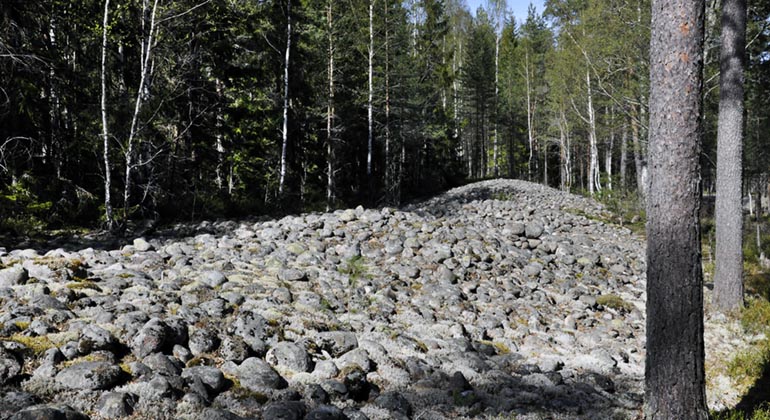
Klapperstensfält i Lövbrickan.
Foto: Elisabeth Karlsson
Lövbrickan, Naturreservat
- Naturreservat
- Amt: Örebro län
Handlinger
Beskrivelse
The Lövbrickan nature reserve is like a chapter in a schoolbook about how the landscape was shaped after the ice sheet. When the ice sheet retreated, Lövbrickan lay on the shore of the great sea formed by the meltwater. In the reserve, you can see clear traces of the ice sheet in the form of embankments and shingle fields.
Highest coastline
10,000 years ago, the whole of the Närkes Plain was covered by a large sea, the so-called Yoldia Sea, which was a precursor to today's Baltic Sea. The shoreline went all the way up to Lövbrickan. This boundary, the highest coastline, is today about 160 meters above sea level. At the shoreline, the waves of the sea worked the loose material and brought gravel and sand out onto the seabed, what is now Närkeslätten. The larger stones remained and were ground round against each other by the movement of the waves, just like on today's sea beaches. Together, these stones formed long beach embankments, known as shingle fields.
Shore walls and dead ice pits
As the water level dropped, new shorelines were formed. In the southern part of Lövbrickan, there is one of the finest sea walls in the area, in the form of a 300-metre-long shingle field, almost completely free of vegetation. In the northern area, there are about ten larger embankments in one area. They have a height of about 75 cm and are clearly visible in the landscape. There are also traces of several dead ice pits in the reserve. These are the remains of large ice blocks that have been embedded in gravel and sand, which then formed large pits when the ice blocks melted.
Tracks of the ice river
In Lövbrickan, an ice river has formed a so-called ice river delta. This ice river originated in a crack in the ice sheet. The water of the ice river carried rocks, gravel, sand and clay particles. When the ice river reached the sea, the water was slowed down. The material that came with the water fell to the bottom. First, larger boulders and stones, while finer-grained material, such as sand and clay, followed further out into the delta. Much of the fine-grained material was carried further out to sea. Here in Lövbrickan, the ice river has formed a pebble ridge both above and below sea level. The parts that ended up above the water surface were never exposed to the waves. Instead, stones, gravel, sand and the finest clay particles are mixed in the surface layer of the ground. The area below the sea surface, on the other hand, lacks the finer particles of sand and clay, as they were easily carried by waves and currents to the bottom of the sea.
Sign language information
Autumn excursions
Geological sights
Aktiviteter og faciliteter
- Naturreservat
Fakta
Municipality: Örebro
Established in: 1979
Area: 17 hectares
Landowner: Örebro municipality
Manager: County Administrative Board
Reserve creator: County Administrative Board
Rutevejledning
From Örebro, drive towards Frösvidal and then follow signs. Turn left at T-junction in the gravel pit. Park at small information board, from where a path leads.
Regler
In the reserve it is prohibited to:
- make a fire
- break branches, cut down or otherwise damage living or dead trees and bushes
- park other than in a specially designated place
- camping or setting up a caravan
- remove or move stones in the clapper banks
- put up a picture, poster, billboard, sign, inscription or similar
Kontakt
E-mailadresse
Organisationens logotype
Jeg har været her 1

Jeg vil gerne derhen 1
Spørgsmål og svar
Stil et spørgsmål til andre Naturkartan-brugere.
Anmeldelser
0 anmeldelser
- 5 :
- 4 :
- 3 :
- 2 :
- 1 :
Brugernes billeder
Der er endnu ingen brugerbilleder. Vær den første til at dele et!