
-
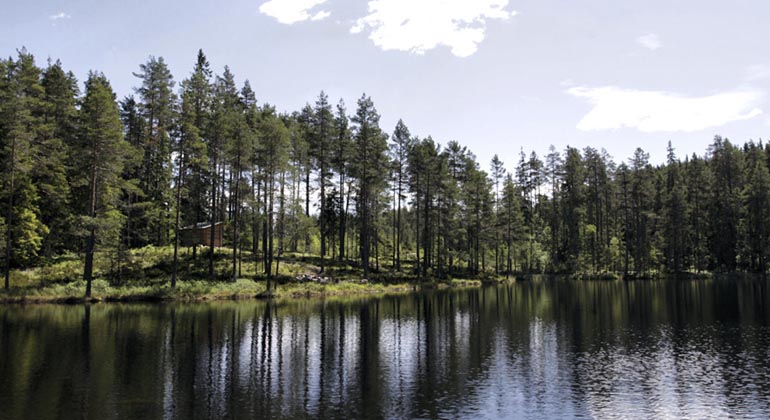
Ljustjärnsskogen.
Foto: Kjell Store
Ljustjärnsskogen, Naturreservat
- Naturreservat
- Amt: Örebro län
Handlinger
Beskrivelse
The Ljustjärnsskogen nature reserve is a varied forest area. There are trees of different ages and both open and closed environments. There are traces of both forest fires and coal production in the forest. The reserve is home to unusual lichens, fungi, mosses and animals, species that cannot live in our normal production forests.
Ground covered in moss
The old spruce forest stands tall among the small mountains on the slopes around the magical little Ljustjärnen. The old paths that crossed the area are still visible in the dark forest on the south-eastern slope towards the tarn. On the slopes of Kroktjärnsberg, the spruce forest grows densely and the dark, damp ground is covered by a thick layer of moss. On the slopes of the mountain there are plenty of hanging lichens in the trees, including the rare violet-gray
thorn lichen.
Animals and plants that thrive in old forests
The forest in Ljustjärnsskogen is varied in many ways. There are many old trees in the area, but also many dead trees. The spruce bark beetle, the border tick and the woolly tick are examples of fungi that grow on fallen dead spruce or pine trunks. If you are lucky, you may see both the three-toed woodpecker and the capercaillie. The three-toed woodpecker is dependent on dead or dying trees where it finds much of its food in the form of bark beetles. Some examples of rare lichens that have been found in the reserve are shadow blue lichen, broktagel and Norwegian beak lichen. Look for them on boulders with sharp sides in damp locations.
Traces of coal production
Here and there in the forest are traces of charcoal production, in the form of charcoal heaps where the charcoal kiln once stood. Charcoal making was an important source of income for the local crofters. The finished charcoal was used to make iron in the ironworks. There are also traces of several forest fires in the area, in the form of sooty stumps and wounded trunks of older trees.
Accessibility
A marked path runs around the lake. Near the parking lot there is a shelter with a fireplace.
Is there firewood?
Firewood is available at the fire pit. Remember to burn in moderation, so that there is enough firewood for future guests. The firewood is replenished regularly, but we cannot guarantee availability at all times. If you want to be sure to be able to make a fire - bring your own firewood. It is not allowed to burn sticks and branches from the forest in the reserve.
Aktiviteter og faciliteter
- Naturreservat
Fakta
Municipality: Ljusnarsberg
Year established: 2002, expanded in 2005
Area: 95 hectares
Landowners: Swedish Environmental Protection Agency and individuals
Manager: County Administrative Board
Reserve creator: County Administrative Board
Rutevejledning
From Ställdalen, take the direction "Kumlan". Continue 2.6 km to L. Kumlan. Take towards "Norrmossen". After 1.5 km, follow sign "Naturreservat". Parking and fireplace are after 2.7 km. NOTE: The road goes steeply uphill and is quite bad at times.
Regler
In the reserve it is prohibited to:
- break branches, cut down or otherwise damage living or dead trees and bushes,
- collecting mosses, lichens, wood-living fungi, insects or other invertebrates,
- making fires
- organizing cut trails
Kontakt
E-mailadresse
Organisationens logotype
Jeg har været her
Jeg vil gerne derhen 1

Spørgsmål og svar
Stil et spørgsmål til andre Naturkartan-brugere.
Anmeldelser
0 anmeldelser
- 5 :
- 4 :
- 3 :
- 2 :
- 1 :
Brugernes billeder
Der er endnu ingen brugerbilleder. Vær den første til at dele et!