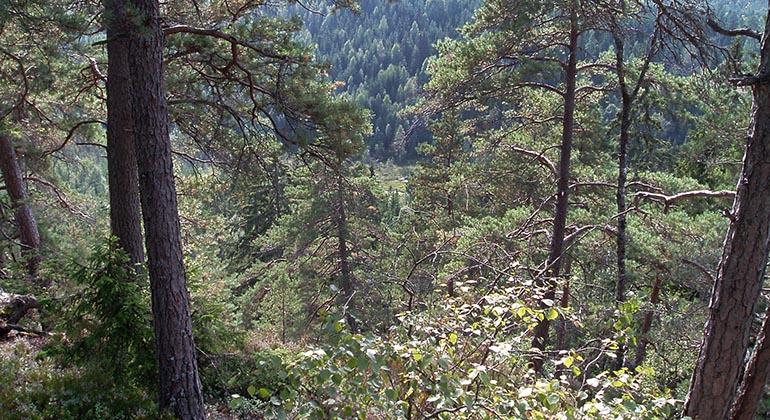
The Klunkhytte skans nature reserve is named after the remains of the ancient castle located on a hilltop in the reserve. The area around the ancient castle was protected as a domain reserve as early as the 1940s, so the forest has been allowed to develop freely for more than 50 years. There are plenty of old and dying trees with clear evidence of woodpeckers, including the three-toed woodpecker.
Many woodpeckers thrive here
The area around the ancient castle was protected as a domain reserve as early as the 1940s, and the forest has since been allowed to develop freely. There are plenty of old and dying trees with clear traces of woodpeckers, including the three-toed woodpecker. The ridge on which the forest is located is bounded by several rocky slopes with steep, boulder-rich slopes in between. The slopes mainly face southwest and thus have a warm local climate. The whole area is above the highest coastline.
Unusual plants
The warm slopes are home to deciduous trees and several other heat-demanding species. Many species also benefit from the fact that the bedrock contains lime. The mountain bracken, haymaker's broom, lentel and lesser celandine are some of the rare plants found in the reserve. The tibia flowers here in early spring on bare twigs. The fungal flora is also varied, with rare species such as the lily of the valley and the green-footed rush.
An ancient castle from the Iron Age
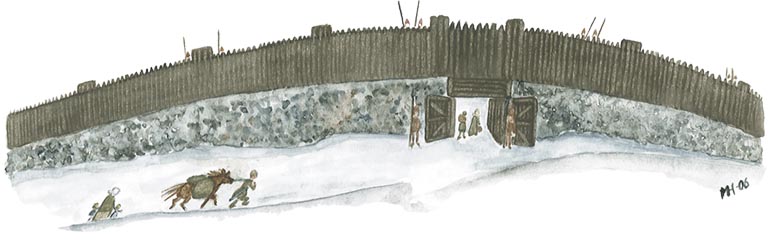
Up on the mountain ridge are the remains of an ancient castle from the Iron Age (500 BC-1050 AD). The site provides a good view of the landscape and the steep slopes gave the castle natural protection in one direction. On the other sides, the castle was protected by semi-circular stone walls. Remains of these walls exist today in the form of two stone ramparts. The longest and strongest rampart is about 70 meters long with an entrance in the northeast.
Facts about ancient castles
Ancient castles fascinate people and there is something exciting and mysterious about them. What did they look like? What were they used for? Who used them? What era are they from?
Many ancient castles in Mälardalen
There are almost 2,000 ancient castles in the Nordic countries, and just over half of these are in Sweden. There are different types of ancient castles in different areas of Sweden, and the densest concentrations are in the Mälar region, along the west coast, in Östergötland and northern Småland. On Öland and Gotland there are also so-called lowland castles, which are quite different from those on the mainland.
The first researchers
Ancient castles have fascinated people over the centuries. The very first records of the country's ancient castles were made back in the 17th century. At that time, the main focus was on inventorying the location and appearance of castles. In the 1930s and onwards, the step was taken to start investigating the castles. The first archaeological investigations were carried out by archaeologists such as Ivar Schnell, Sten Anjou, Arthur Nordén and Mårten Stenberger.
What are the different types of castles?
Throughout history, ancient castles have been classified in different ways. The earliest is a pure description of what the ramparts look like. Are there one, two or three ramparts, and did they use rocky outcrops to build the castle? Then people started to take a little more interest in where the castles are located in nature. Are they built high up on a mountain? Or are they down in the lowlands? After that, people became more interested in their function. Is it possible that people sought shelter in the castle? Are there many ancient monuments nearby? Is the site close to waterways where people could keep a close eye on who was traveling across the water? Have they been used as burial sites or are they more of religious importance? Was the castle perhaps used for living in?
What were the castles used for?
It was long believed that all ancient castles were places of refuge during troubled times, especially during the Migration Period (400-550 AD). At that time, there was no thought that the castles could have been built for reasons other than external threats, and this was long believed. Today there are several researchers who have new theories about these ancient castles. Calling all places ancient castles is not quite right, but they are often registered as ancient castles in the Swedish National Heritage Board's ancient monuments register. Other names used are ramparts or enclosures. Many castles have been used as protection in times of unrest. Other castles have been used more for religious and cultic purposes. The sites are often located on high ground and have had a good view of the surroundings. It has been a natural vantage point used to look for signals in the landscape and from other ancient castles nearby. Whatever the reason for building the castles, they have been a significant feature of the landscape and have brought many people together.
Örebro County's ancient castles
There are 34 registered ancient castles in Örebro. Most of them are located at high altitude and overlook the surrounding areas. Some castles overlook several castles while others only look over to another castle. Many of the ancient castles are located in Kilsbergen along the edge and they all look out over Närkeslätten, for example Borgaresjö skansar, Tistaborg, Ullavi klint. They have not had the main contact with each other but have instead looked out over the plain and the ancient castles located on a band in the southern part of the plain area, for example Tarstaborg. These ancient castles in turn look back towards the ancient castles of Kilsbergen.
Accessibility
Klunkhytte skans belongs to level 1 in the County Administrative Board's leveling of the county's nature reserves, which means that the reserve has a wilderness character and lacks outdoor recreation facilities.