Ekåsen, Naturreservat
- Naturreservat
- Landsdel: Örebro län
Handlinger
Beskrivelse
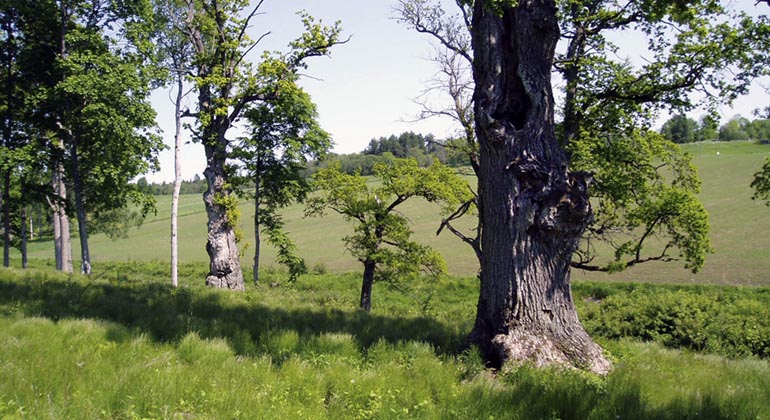
Ekåsen Nature Reserve is located in the drumlin landscape of the Närkes plain with a view of the blue horizon of Kilsbergen in the northwest. Many giant oaks grow in the reserve. There are three burial grounds from the Iron Age in the area, which show that humans have been here for a very long time.
Old oak landscape
Ekåsen Nature Reserve is home to mighty old oaks that are between 250-500 years old. Many different species need the oaks to be able to live, forage and find nesting sites. The oaks are home to wood pigeons, skylarks and barn owls. Stonechat and nuthatch thrive in the crowns of deciduous trees. The area is home to many rare lichens and wood fungi, many of which find the oak tree a vital habitat. Some of them are the oak oak, oxeye mushroom and coral tick. The county's second largest oak stands on Domarbacken. It is seven meters in circumference and began growing about 500 years ago. In the southernmost pastures, there are heath-favored plant species such as buckwheat, briar, cowslip, sedge, red campion and small and large bluebells. The orchids green night-flowering violet and helleborine are also found in the reserve.
The leatherback beetle likes decaying oaks
The rare leatherback beetle can be found in several of Ekåsen's oaks. The leatherback beetle is a beetle that lives in old oaks that are rotten and hollow inside. There you can find another 20-30 species of very rare small animals, all of which depend on the survival of old oaks in sufficient numbers. The leatherback beetle spends most of its life as a larva in the so-called 'mulm', the loose inner lining of decaying oak trees. The adult beetle is 3 cm long and brown in color. During high summer, it crawls around on the hollow oaks and is most active at dusk.
Drumlins and burial grounds
Ekåsen is part of one of the country's finest drumlin areas. A drumlin is a flat, arched hill that was formed during the Ice Age. The dry, solid drumlin ridges were used early on as travel routes and settlements. There is evidence that people have lived in the area since the Neolithic period. In the southern part of the reserve are two burial grounds, Domarbacken and Vilsta ör, with a total of about 140 graves from the Iron Age (50 BC-1050 AD). Just east of these burial grounds is a trapping pit where wolves are said to have been caught in the past. In the northeastern part of the reserve there is another burial ground with about 20 graves from the Iron Age. To the north of this burial ground are two hollow ways. A hollow way is an older road that has been worn down through long use and looks like a bowl-shaped gutter in the ground.
Sign-interpreted information
Aktiviteter og faciliteter
- Naturreservat
Fakta
Municipality: Lekeberg
Year established: 2001
Area: 48 hectares
Landowner: Private
Manager: County Administrative Board
Reserve creator: County Administrative Board
Natura 2000: parts of the area are part of the EU's network of protected nature, SE0240056 Ekåsen
Rutevejledning
From Hackvad church, go north 200 meters. Turn right at the crossroads, continue 900 meters. Sign to the reserve, which is on the left side.
Regler
In the nature reserve it is forbidden to:
- damage the surface of the ground
- disturbing wildlife
- pick flowers, woody lichens or fungi, or otherwise damage vegetation by picking or digging
- make a fire
- camping
- using a radio, tape recorder or CD player in a disruptive manner
- drive a motor vehicle or ride a bicycle other than on the access road to the parking lot or in the parking lot
- put up a board, poster, poster, sign, inscription or similar
- organize marked trails
Kontakt
E-mailadresse
Organisationens logo
Jeg har været her 2
Jeg vil gerne derhen 2
Spørgsmål og svar
Stil et spørgsmål til andre Naturkartan-brugere.
Anmeldelser
0 anmeldelser
- 5 :
- 4 :
- 3 :
- 2 :
- 1 :
Brugernes billeder
Der er endnu ingen brugerbilleder. Vær den første til at dele et!