Misterhults skärgård, Naturreservat
- Naturreservat
- Landsdel: Kalmar län och Öland
Handlinger
Beskrivelse
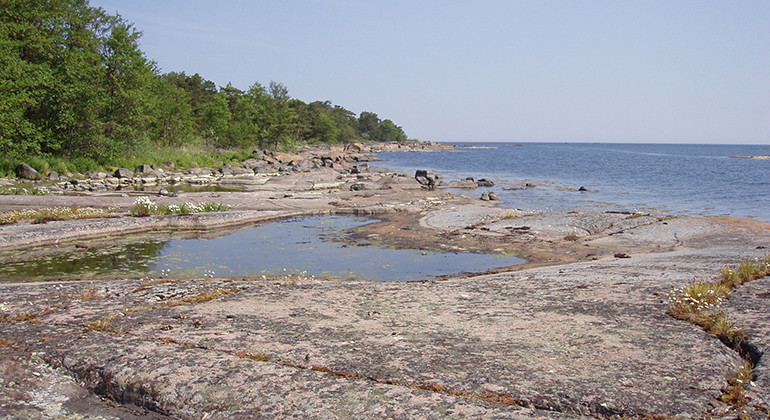
The Misterhult archipelago is one of the county's largest nature reserves. Among some 2000 islands, islets, skerries, rocks and boats, you can experience a piece of archipelago nature at its best. Here you will find bare rocky outcrops with nesting seabirds, islands with old village centers and flora-rich land, as well as forested islands where unusual species linked to dead wood have a sanctuary. Many different species of fish spawn in the protected archipelago, and gray and harbor seals thrive in the outer archipelago.
What's new in the reserve in 2025
The county administrative board's budget for nature conservation and outdoor life sometimes changes and right now we have less money to allocate. The priority is then to manage our natural values in the first place and outdoor recreation facilities in the second place. As a result, this year we are closing a number of toilets in reserves and removing rubbish bins in several protected areas in the county.
In Misterhult, the toilets on Brändö, Stora Vippholmen, Älö and Vinö are all affected and all waste management ceases.
Welcome out into nature
Authentic fishing villages, deep pine forests, lush deciduous forests and a rich plant and animal life both above and below the surface - Misterhult's archipelago offers an archipelago experience beyond the ordinary. There is no regular boat service, so to get out into the archipelago you need to have your own boat. Or kayak, the archipelago is popular paddling waters. To protect nesting birds and seals when they give birth to their young, there are a number of areas in the Misterhult archipelago that are bird and seal protection areas. Where the areas are located and what time of year it is possible to visit the areas is shown on the reserve map below. Fishing with hand gear is free, but you are not allowed to fish with fixed gear such as nets or bottom nets.
Valuable cultural environments
People have lived and worked in the archipelago since the Bronze Age. In several places, there are substantial cairns and other grave forms. In the outer archipelago, there are empty buildings from the 11th-13th centuries, the remains of simple buildings that fishermen stayed in when they were fishing. The archipelago was populated by settlers in the late Middle Ages. Since then, generations of archipelago farmers have used the land and sea for their livelihood. Agriculture has been the main industry, but fishing and hunting have also been important. Today, there are almost no living archipelago farms left, but several islands still have their genuine village structure. On Örö and Marsö the meadows are still mowed and on Älö there are grazing animals.
Rich plant and animal life
The islands of the nature reserve have many different types of habitats, from bare rocks in the outer archipelago to lush deciduous forest, grazed pastures and lean pine forest in the central and inner parts. For those interested in botany, a visit to Örö is a must. With its more than 400 species, the island is the archipelago's most species-rich when it comes to vascular plants. The village's hay meadows account for a large part of the species richness, where tar flower, cowslip, light coneflower, bloodwort and tulkwort grow. On several of the reserve's islands there are valuable rocky forests, deciduous coniferous forests and deciduous groves. The forests are full of dead trees, both standing (dry bark) and lying (flames), and hollow trees. Many lichens, fungi and insects live on and in the dead wood. Adjacent to the old farmland are trees that have been used for harvesting leaves (pollarded trees). These trees are also important for many species, especially beetles and lichens.
Rich in birds
Misterhult's vast archipelago is an excellent environment for seabirds. Eider, lapwing, greylag goose, grebe and many more thrive here. Less common species include skuas and razorbills. White-tailed eagles are once again a common sight, after being almost extinct in the 1970s and 80s. Barn owls have also recovered and are seen regularly.
Below the surface
Three quarters of the reserve's surface is water. Beneath the surface are rich marine environments with seaweed belts, mussel beds and eelgrass beds. The protected archipelago provides important spawning grounds for herring, whitefish, perch, pike and many other fish species. The shallow marine areas are also valuable for a wide variety of seabirds, which have everything from small crustaceans to fish on their menu.
Tones from the sea
After a sharp decline in the number of gray seals in the 1980s, the gray seal is once again a characteristic species in the archipelago. In the northern part of the reserve is the Örö sankor seal sanctuary, where the seals spend much of the year and also give birth to their young. On calm days you may be lucky enough to hear their distinctive song. Harbour seals are also found in the archipelago.
The four inhabited islands in the reserve
Örö
Örö in the northeastern part of the archipelago is distinctive. It is dominated by oak forests in an otherwise pine-dominated archipelago. In addition to oak, the deciduous forests also contain aspen, birch, alder, rowan and oxel. Örö is the island in the Misterhult archipelago with the highest number of vascular plants - over 400 species. The village has hay meadows that are traditionally mown by the village team. They are rich in flowers, with tar flowers, cowslip, light coneflower, bloodwort and tulkwort. On the western part of the island, Hartman's sedge occurs sparsely in leafy margins. This is its only habitat in the municipality.
Strupö
Strupö boasts an unusually sheltered natural harbor that was probably much sought after in older times. The village has also had its natural place here in the harbor ever since the island was inhabited. The buildings are well clustered and most of the farms date from the late 1800s. The island's history lies primarily in its position as a pilot lookout, between 1666 and 1933 there was a pilot station built here. Today you can walk a nature trail around the island, including up to the place where the old pilot lookout was located.
Älö
Älö is a very hilly island, the highest point reaches 24 meters above sea level and although most of the island is significantly lower, the steep, sharply cut rocky knobs dominate the visual impression. On the south-eastern part of Snuggö there is grove-like vegetation. Such areas are quite unusual in the archipelago, and here you will find musk, red bladderwort, spinach, whitethorn, lesser celandine, larkspur and toothwort.
Marsö
Marsö is located in the southernmost part of the nature reserve Misterhults norra skärgård. At the center of the area is the main island of Marsö with its fishing village, old hay fields and traces of old archipelago farming. On Kuggen, opposite Marsö, there are no buildings. Instead, there are lichen-covered rocks, marshes and water lily-covered pools that give the visitor a magical and wild impression.
Visitor information
Strupö is a popular island for canoeists - however, there is no fresh water on this island.
Hiking trails are available on Örö and Strupö. There are hiking trails on several other islands, including Marsö and Älö.
Visitors are also welcome to land with their own boat on the inhabited islands. Always ask where it is appropriate to dock so that you do not disturb other traffic.
Dry docks on Brändö, Älö, Stora Vippholmen, Örö and Istergås are closed.
Aktiviteter og faciliteter
- Naturreservat
Fakta
Decision year: 2013
Area: 8450.5 hectares of which 1559.2 hectares is land
Municipality: Oskarshamn
Landowner: Individual
Administrator: Kalmar County Administrative Board
Rutevejledning
The reserve extends from just south of Blankaholm to just north of the Oskarshamn nuclear power station in Simpevarp. The most accessible harbors are in Misterhult, Klintemåla and Kråkemåla. There is currently no regular boat traffic in the northern archipelago of Misterhult.
Regler
In the nature reserve you are not allowed:
- During April 1 - July 10, you are not allowed in the areas marked on the map at the bottom of this page, or in the reserve itself. You may not stay closer than 100 meters from islands and skerries.
- Drive a motorized watercraft inside land areas.
- Drive a motorboat or other motorized craft in the water area at a speed greater than 10 knots.
- Driving or landing a hovercraft, hydrocopter, low-flying aircraft or similar craft.
- Driving a jet ski or water skiing.
- camping in the same place for more than 24 hours
- Mooring or anchoring a boat for more than 24 hours in the same place.
- Discharging toilet waste from a boat.
- Driving or landing low-flying aircraft.
- Climbing trees with nests.
- Being near a bird of prey's nest, lair or burrow.
- Deliberately disturbing wildlife.
- Bringing a dog, or other animal, that is not on a leash.
- Make a fire anywhere other than in designated areas, in a barbecue you have brought or in an open-air kitchen.
- Picking or damaging mosses, lichens or wood fungi.
- Digging or pulling up vascular plants.
- Damage or remove trees, stumps, bark, branches, shrubs or brush that are growing or dead.
If you have obtained a permit from the County Administrative Board, you may:
- Set traps to collect insects.
After consultation with the County Administrative Board, you may:
- Conduct survey or research.
Full regulations
C. Regulations for the public according to Chapter 7, Section 30 of the Environmental Code on the right to travel and stay in the reserve and on order in general within the reserve.
It is forbidden to enter the reserve:
- during the period 1 April to 10 July in areas marked with a red grid on the attached decision map, Appendix 1, stay on or travel closer than 100 meters from islands and skerries.
- drive a motorized vehicle within land areas
- operate a motorboat or other motorized craft at a speed exceeding 10 knots outside the public fairway
- operate a hovercraft, hydrocopter or similar craft other than along marked fairways
- operate personal watercraft or similar craft other than along the centerline of the marked fairway of public fairway No. 304
- water skiing
- camping for more than one day in the same place
- mooring or anchoring a boat for more than 24 hours in the same place
- Discharging toilet waste from a recreational boat.
- Flying low-flying aircraft or landing with an aircraft.
- Climbing trees, staying near a bird of prey's nest, lair or pot, or otherwise deliberately damaging or disturbing wildlife.
- Bring an unleashed dog or other loose pet.
- Make a fire other than in a barbecue or outdoor kitchen.
- Pick or damage wood fungi, mosses or lichens.
- Digging or pulling up vascular plants.
- Damage or remove growing or dead trees, stumps, bark, branches, bushes or brush.
It is forbidden to do this without the permission of the County Administrative Board:
- set traps for the collection of insects.
It is prohibited without consultation with the County Administrative Board:
- conduct field surveys or research on animal or plant species or on soil or water conditions.
The regulations under C do not preclude the professional practice of emergency services personnel, police or customs personnel, coastguard personnel, medical personnel or veterinarians or in other comparable, urgent cases.
The provisions of point C do not preclude measures required for defense-related activities.
The regulations under C do not preclude the keeping of the fairway and the operation and maintenance of marine safety equipment.
Regulation C does not preclude the maintenance of existing pipelines and the maintenance clearance of existing utility corridors.
Regulation C 1 does not apply to the landowner or his employees in connection with the exercise of their profession, the maintenance or supervision of the property or in connection with subsistence fishing. The prohibition also does not apply to state or municipal officials in their official capacity or to professional fishermen in their professional capacity. Nor does the ban prevent year-round residents of the archipelago from traveling along traditionally used trails.
The regulations under C 2-4 do not apply to commercial traffic for residents within the reserve.
The regulations under C 2-4, C 7-8 and C 11-17 do not apply to owners or holders of special rights to property or holders of other rights. Within regulatory area A, however, regulations C 13-17 also apply to owners or holders of special rights to real estate or holders of other rights.
Regulation C 7 does not apply within vacant land or other land directly adjacent to the development after obtaining permission from the landowner or holder of a special right to the property in question.
Regulation C 8 does not apply when weather conditions do not permit continued travel. The regulation
C 8 also does not apply to existing jetties or water areas adjacent to buildings after permission has been obtained from the property owner or holder of a special right to the property in question.
Regulation C 11 does not apply to fishing or hunting under current hunting legislation.
Species observations of red-listed species from activities conducted in accordance with C 17-18 must be documented and reported via www.artportalen.se or to the County Administrative Board.
Kontakt
E-mailadresse
Per Markus Jönsson
Organisationens logo
Jeg har været her 1
Jeg vil gerne derhen 2

Spørgsmål og svar
Stil et spørgsmål til andre Naturkartan-brugere.
Anmeldelser
0 anmeldelser
- 5 :
- 4 :
- 3 :
- 2 :
- 1 :
Brugernes billeder
Der er endnu ingen brugerbilleder. Vær den første til at dele et!