
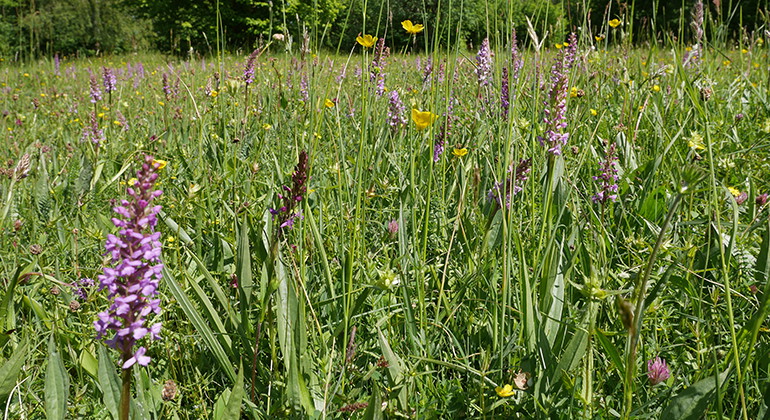
A beautiful small hay meadow that is still mown. There are many pollarded trees and hazel bushes. Unfortunately, ash dieback has hit the trees in the meadow quite hard but it is still a magical place to visit when the meadow is in bloom!
Lilla Horns löväng is a small remnant of a now almost disappeared landscape type created by purposeful work by people over centuries. For 2000 years, the meadow was the most important type of land in our country. In the 1850s, there were still over two million hectares of meadows in Sweden. The deciduous meadow was nature's larder, helping people and animals to survive the winter. It was created by clearing the land and leaving single trees, such as ash, lime, birch and hazel. The trees had to be sparse. Sun and partial shade favored the meadow plants.
The deciduous meadows were managed using old methods. In the spring, people gathered together for hoeing. Leaves and twigs were raked up to stimulate grass growth and make the meadow easier to mow in summer. No animals were allowed to graze in the meadow after the felling. In early July, people gathered for mowing. Grass and flowers were cut with a scythe. The hay was dried and used to feed the animals during the winter. The cattle were not allowed to graze in the meadow until the hay had been gathered. The trees in the deciduous meadow were tamed by pollarding. This involved cutting down the tree's branches and leaves, which were saved to feed the cattle during the winter.
The deciduous meadow became nutrient-poor over time - the farmer removed the vegetation every year. That's why broadleaf meadows have particularly hardy plants that are also adapted to the bright, open landscape and annual mowing. The well-managed broadleaf meadow is one of the richest habitats in our country. There can be around 40 different plants on one square meter. A number of meadow plants grow in Lilla Horn, including cowslip, meadowsweet, maidenhair fern, hay flower, pig's-foot and sedge. The collared flycatcher also lives here. It is a bird that feeds on insects and likes to live in hollow trees.
Bird life in the meadow is relatively rich. Robins, blackbirds, stone curlews, yellowhammer and cuckoos nest here. However, the most characteristic species is the collared flycatcher, which thrives best in leafy meadows with pollarded trees.
The insect life is poorly known, but the endangered bristle beetle Dasytes nigrocyaneus has been found.
Lilla Horns löväng has a very rich fungal and lichen flora. Many species are red-listed. Most fungi are linked to the open and semi-open environments of the old hay meadows. Many of the fungi are found in the open parts of the meadow. These include the yellow-footed clay fungus, light meadow finger fungus and eye wax fungus. On the trunks of the old trees there are many rare lichens: old oak lichen, pink shield lichen, gray shield lichen, orange-powdered scribble lichen and pink grove lichen.
There are several ancient monuments in the meadow. Strings of stones run through some parts, the remains of very old stone walls. They leave their mark on the meadow by dividing it into different "rooms". In several places you can also see low stone cairns. They probably originate from the temporary arable farming that took place in Lilla Horns löväng.
Year of decision: 1981
Area: 8 hectares
Municipality: Borgholm
Landowner: Private
Administrator: Kalmar County Administrative Board
Approximately 3.5 miles N Borgholm, follow signs for Lilla Horn from road 136.Parking is in the parking lot on the opposite side of the road at the reserve.The fences into the meadow are replaced with self-closing gates and footbridges are laid over the ditches.
In the nature reserve you are not allowed:
C. Regulations under Section 10 of the Nature Conservation Act on what the public must observe within the nature reserve.
It is forbidden to
Per Markus Jönsson

Stil et spørgsmål til andre Naturkartan-brugere.
0 anmeldelser
Der er endnu ingen brugerbilleder. Vær den første til at dele et!