
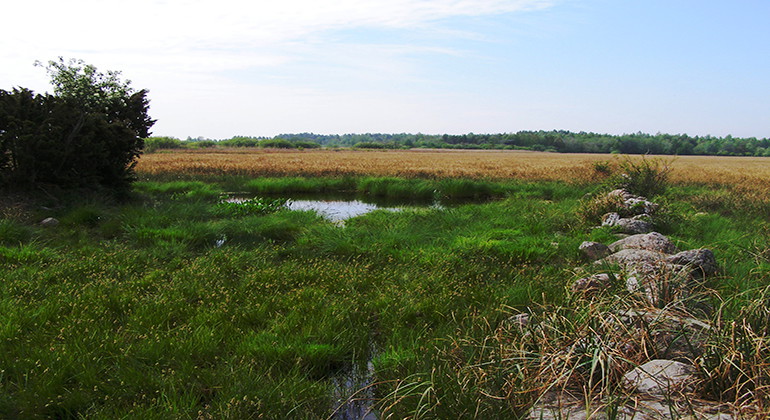
Djurstad swamp is a large agmyr. The swamp is surrounded by species-rich pastures with a rich bird life.
Djurstad swamp is a large agmyr. Drilling has shown that the peat thickness in the central part of the swamp is one meter. In the northern part of the swamp, agen forms almost completely pure stands. Where the agar is sparser, there are elements of plants such as duckweed, grass, water milfoil and various creeping algae. Leaf litter occurs in almost the entire wetland and often forms small pure stands. In addition, there are fairly dense stands along the ditches and marsh edges.
A large, completely open, permanent water surface used to be in the southwestern part of Djurstad Swamp. Nowadays it dries out during the summer. This part is covered in sedges with elements of torch flowers, marsh willowherb and water milfoil. Where the meadow thins out, occasional patches of bunchgrass take over.
The swamp's edge zones towards the surrounding land are occupied by various types of moist grasslands. Bluebells, meadowsweet, tufted sedge and tall herbs are among the dominant plants, with clubmoss occurring more rarely. The presence of orchids such as honeycreeper, flyflower and marsh marigold is typical. In the southwestern part there is a narrow strip of axa vegetation in the transition to the surrounding solid ground. This rich marsh plant is relatively uncommon on Öland and indicates a mobile and lime-rich groundwater.
Djurstad swamp is surrounded on several sides by valuable natural pastures. In the northwest, they consist of dry and herb-rich grassland that is overgrown with some juniper bushes. The pasture is very rich in species, with plants such as wild bread, coneflower, goat's beard, chickweed and wild flax. In this part you can see heather, a now rare plant that today occurs mainly on traditionally managed pastures.
Djurstad swamp is perhaps best known for its rich bird life. About 20 wetland-associated bird species nest in the swamp. Among the most common are saw-whet sparrow, reed warbler, crane, mallard, mallard and graylag goose. Meadowhawks and brown harriers are among the area's characteristic species and are regular breeding birds. Since mowing has resumed, waders such as lapwings and redshanks have increased in number.
Gray-legged Fritillary, which has only been found on Öland and Gotland in the whole world, has a rich population here. Streaked swamp moth, torch rose spring moth, meadow spoonbill, four-spotted moth, brown-eared dwarf moth, rocking fly moth and yellow-gray reed fringe moth are other examples.
Djurstad swamp was previously a lake, which was lowered in the 1920s to create more arable land. After the lake was drained, the wetland was used for haymaking. The last time hay was cut was in the dry year of 1959. In the northern part of the wetland, haymaking has resumed in recent years.
Visitors have good opportunities to study the birds from the bird tower. Please note that during the period when there is a trespassing ban, April 1 - August 15, it is only allowed to stay on the footpath.A footpath leads from the parking lot to the bird tower.
Year of decision: 1980
Area: 87.1 hectares
Municipality: Borgholm
Landowner: Individual
Administrator: Kalmar County Administrative Board
Djurstadträsk is located on the eastern side of Öland about 5.5 km south of Föra. Signs show from road 136 and parking lot is along the road.
In the nature reserve you are not allowed:
C. Regulations according to Chapter 7, Section 30 of the Environmental Code on the right to travel and stay in the reserve and on order in general
In addition to what is prescribed by law and regulation, the public shall be prohibited from within the area
Per Markus Jönsson

Stil et spørgsmål til andre Naturkartan-brugere.
0 anmeldelser
Der er endnu ingen brugerbilleder. Vær den første til at dele et!