Mörbylånga kommun - Öland
Välkommen till vårt fantastiska friluftsliv i v...

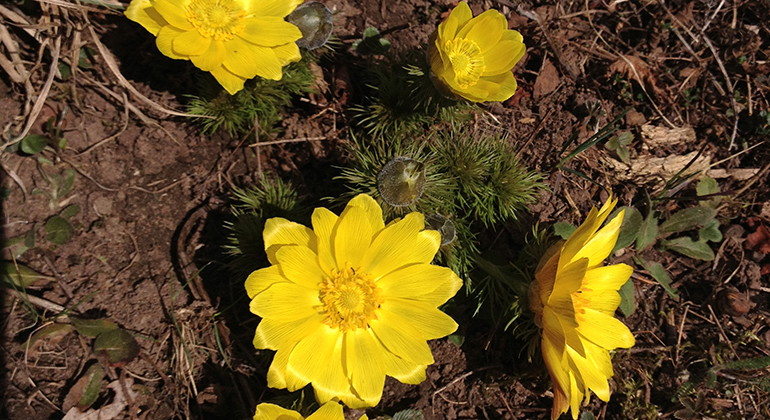
A rarity that attracts many visitors to this reserve is the yellow-flowering beauty spring daisy. This rare plant can only be seen in a few places in the country. In the reserve you can also experience a typical island deciduous forest, rich in flowers and birds.
The spring daffodil, also known as the Arontorp rose, is the reserve's number one attraction. When it blooms in April-May, people flock to the small meadow in the west. It's important to pick a sunny day when the flowers are out. Even one of the spring daffodil's faithful guests, the black- and red-patterned knight beetle, is mainly present when the weather is nice. The spring daffodil only grows on calcareous soil and is only found in Sweden on Öland and Gotland. In addition to the spring daisy, there are many other exciting things to discover in Arontorpängen in the summer. Spring daisy is not the only rare plant in the reserve. The wet meadows to the east are home to the large violet. It can grow several decimetres high and flowers in May-June. In Sweden, the large violet only grows on Öland. If you are here on a still, sunny summer day, you will see butterflies flying from flower to flower. The more unusual ones include the meadow butterfly and the cowslip butterfly. For spring daffodils to spread, the flowers need to be pollinated. Sand bees help with this. When a sand bee lands on a flower, pollen sticks to its body, which it carries to the next flower, which is then fertilized and can form seeds. In return for their help, the bee gets nectar. They also collect pollen to feed their young. To protect the sand bees, small patches of soil are created each year in the turf at strategic points in the reserve. Here the bees can dig out their nests.
In the 19th century, the site of the spring dune was used as a field. As a result, the species almost disappeared. However, the specimens that grew next to protruding limestone blocks, where the plows could not reach, survived. With the end of arable farming, the number of spring begonias increased. Today, overgrowth is a threat to the rare flower. That's why the ground around the plants is mowed every year. Another threat is picking and digging, which is not allowed as the spring daisy is protected.
Most of the reserve is covered in deciduous forest. A walk through the forest in spring and early summer offers colorful flowers. Among the blue, yellow and white lilies grow spring pea and larkspur, which add pink to the color palette. At this time of year, the forest is also filled with birdsong. Collared flycatchers, garden warblers and blackcaps are just a few examples. As you will notice, some of the trees are dead in the forest. The trees are not removed because they are valuable homes for insects, among others.
The spring daffodil was first discovered in Sweden by Carl Linnaeus on his voyage to the island in 1741. Erik Axel Karlfeldt's poem "Vid Färjestaden" has given rise to the name arontorpsros for the beautiful flower. The flower's Latin name comes from Adonis, who was the god of plants in Greek mythology. Adonis was beautiful and became the lover of Aphrodite. A bear mauled him to death and where his blood fell to the ground, flowers grew.
Spring Adonis, Adonis vernalis, is a flower that is very strongly associated with the arrival of spring on Öland. In the Nordic countries, it is only found on Öland, Gotland and Bornholm and we therefore feel a great responsibility for the species here with us. It lives here on its northern border and otherwise has its distribution from Europe to Central Asia. The Arontorp rose grows in small tufts on calcareous, open and dry grassland. The plant loves warmth, and the flowers open on sunny days but close during rain and in the evening. It is quite special as it lacks nectar but is still pollinated by small sand bees that live in sandy soils nearby. Another important partner of the Arontorp rose is the meadow ants, which spread the seeds they collect but also drop along the way. These become new seedlings and the plant can spread. But the Arontorp rose is not only beautiful and pretty, it is also very toxic! It contains glycosides that affect the heart. The plant has been used as a medicinal plant since ancient times. Despite its toxicity, the Arontorp rose has suffered a lot from illegal digging for sale and planting in gardens. But the plant is protected and today there are fine, cultivated plants to buy in commercial gardens, so we hope that our wild specimens may remain and enrich the nature of Öland.
Year of decision: 1977
Area: 5 hectares
Municipality: Mörbylånga
Landowner: Private
Administrator: Kalmar County Administrative Board
To get to the parking lot, take road 136 towards Ottenby and turn off onto road 957 towards Norra Möckleby and Gårdby. After about 2.5 km you will reach Tveta farm and shortly after that the parking lot is on the right side of the road.From the parking lot there is a well-marked path, partly reinforced with a footbridge, which leads visitors to the reserve. The distance to walk from the parking lot is about 500 m and goes through a piece of beautiful Midland forest that in spring is in its most beautiful dress.At the parking lot there are also picnic tables for those who want to take a break before and after the visit to the reserve.
In the nature reserve you are not allowed:
C. Regulations according to Chapter 7, Section 30 of the Environmental Code on the right to travel and stay in the reserve and on order in general
In addition to what is prescribed by law and regulation, the public shall be prohibited from
Per Markus Jönsson



Stil et spørgsmål til andre Naturkartan-brugere.
0 anmeldelser
Der er endnu ingen brugerbilleder. Vær den første til at dele et!