
Tjolöholms naturreservat
- Naturreservat
- Amt: Hallands län
Handlinger
Beskrivelse
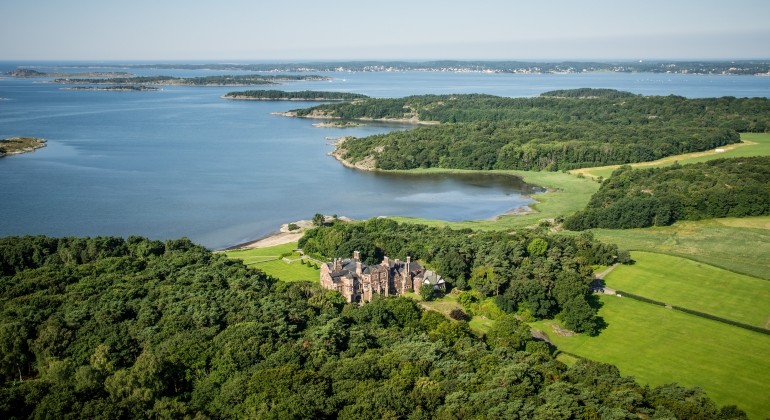
The stunningly scenic area around Tjolöholm Castle on Kungsbackafjorden is one of the most valuable forest areas in Halland County. No less than 117 red-listed and 192 regionally interesting species have been found in the 445-hectare nature reserve. The area is therefore of great national interest for the conservation of biodiversity. Tjolöholm Nature Reserve will be inaugurated on May 31, 2026. The nature reserve consists mainly of deciduous forest, but also of rocky outcrops, pastures, flowering hedgerows and grazed seashore meadows. As early as the 13th century, Tjolöholm was characterized by the nobility and the landscape around the castle therefore breathes manor environment with large fields alternating with forested mountains. Tjolöholm Castle and its surroundings are one of Halland's most popular destinations with 200,000 - 300,000 visitors annually.
A gem for outdoor life
The reserve has nine marked trails in varying environments. In several places, the trails are integrated with centuries-old stone paths and stairs. They run through forests with twisting old oak trees, groves with whitethroats, beach meadows, parks near the castle over bare rocks with beautiful views of Kungsbackafjorden. Some of the trails are on gravel roads and wider paths so that you can get there even with a wheelchair or stroller.
Several opportunities for relaxation
Along the trails there are benches and at the small lake Kvarndammet, also called Bergssjön, there is a shelter and a barbecue area. Just south of the castle and the castle garden there is a beach with barbecue areas, bench tables and a playground. The Tjolöholm Foundation has a large, chargeable visitor parking lot that also applies to visitors to the reserve. Toilets are available at the visitor parking lot and down by the beach.
Coastal broadleaf forests
The hills of the Tjolöholm peninsula and the lower parts of the mountains to the northeast of the peninsula are made up of oak-dominated broadleaf forest. This is one of the few preserved coastal broadleaf forests in Halland that has been continuously cultivated and there are several hundred-year-old broadleaf trees here.
In terms of the area of coastal deciduous forest, Tjolöholm is the county's foremost area. Many species of lichens, mosses and fungi live in the forests, which benefit from the damp coastal climate that Tjolöholm can offer.
There has long been great pressure on the west coast, both for cultivation and exploitation. The older coastal broadleaf forests are only left as rubble at Tjolöholm, Särö and Hördalen.
Tjolöholm's broadleaf forests are home to a wide range of red-listed species, from birds to bats, insects, vascular plants, mosses, lichens and fungi.
Pasture-dominated habitats
Tjolöholm's landscape has been characterized by grazing animals for a long time. Partly the estate's own grazing animals, partly grazing animals belonging to the crofts that were located northeast of the peninsula.
In the eastern parts of Storeskog, at Fasankullen and at the lower parts of Stuteribergen, the clearest tree-covered pastures with large pasture oaks are found, and on the peninsula, west of the castle, there are traces of grazing on all the wooded hills.
In the forests there are walls on the hills. These were probably used to divide grazing between the lighter animals (sheep and goats) on the higher parts of the hills and the heavier animals (cows and horses) on the lower parts of the hills.
The hills of the peninsula used to be somewhat more open than today, and rocky outcrops and heaths were more common. Because grazing is no longer practiced, the forests have become denser. Along almost the entire shores of the peninsula there are narrow strips of seashore meadows with a sometimes species-rich flora.
Nature and cultural heritage management
Oak woodlands are dependent on conservation management to prevent them from becoming overgrown and losing much of their natural value. The oaks need a lot of light to survive, and the insects, lichens, plants etc. associated with oak hedgerows also thrive best when the canopy allows some light through.
Today, not many parts of the pastures are grazed, so clearing of growing bushes and shrubs is necessary to prevent the pastures from becoming too dense and closed.
Arts and crafts - the common thread in the landscape
The current castle was designed by architect Lars Israel Wahlman and built by the Dicksons at the turn of the 19th century in the Elizabethan style. At the same time, the castle garden, the castle park, the gatehouse, the workers' village and the church were built and landscaped. Both Wahlman and the Dicksons were greatly inspired by the Arts and Crafts spirit, which emphasized closeness to nature, craftsmanship and attention to detail. For example, the granite walls of the castle harmonize with the adjacent mountains, the castle garden blends smoothly into the surrounding nature, and the elements of nature interact with the garden.
Blanche Dickson laid out about seven kilometers of stone paths and stairs at Tjolöholm. The paths are spread across Tjolöholm's grounds and in many places form continuous paths that form rooms in the landscape. These rooms are lined with, among other things, winding old oaks, dramatic rock faces, caves and old graves. The paths also often connect to beautiful viewpoints.
Tjolöholm Castle visitor center and monument
The castle with castle garden, castle park, gatehouse, workers' village and church was built between 1898-1904 and was influenced by the Arts and Crafts movement, which affirmed the proximity to nature, craftsmanship and attention to detail. The castle and other buildings are located outside the nature reserve but contribute to the overall experience for visitors to the nature reserve. More information about upcoming events, accommodation, guided tours and more can be found on the Tjolöholm Foundation website.
Aktiviteter og faciliteter
- Naturreservat
Fakta
Dominant habitat type: broadleaf forest, coniferous and mixed forests, fields.
Municipality: Kungsbacka
Area: 445 hectares
Protected since: 2025
Owner: Tjolöholm Foundation
Trustee: County Administrative Board
Rutevejledning
Bus: Bus line 732 runs between Frillesås and Kungsbacka. Get off at the stop Torpa smedja near the entrance to Tjolöholmsvägen. Follow the sign towards Tjolöholms slott and walk Tjolöholmsvägen about 3.5 km.
Car: From E6 take exit 58 towards Fjärås, Åsa and Tjolöholms slott. Turn right onto Varbergsvägen towards Åsa and Tjolöholms slott. After about two kilometers turn right onto Tjolöholmsvägen (see sign Tjolöholms slott). About 3.5 km into Tjolöholmsvägen is Tjolöholms slott's large parking lot.
Regler
To protect the nature reserve, the County Administrative Board has decided on special regulations, including those that you as a visitor to the area must follow and respect.
In addition to what applies under other legislation, it is forbidden to:
- damage living or dead trees, bushes and branches,
- damage, pick or collect mosses, lichens or fungi other than single specimens. However, it is allowed to pick edible mushrooms,
- put up a board, poster, sign, carving or inscription
- drive a motorized vehicle other than on a road or park other than in places designated by the reserve manager,
- set up a tent, shelter, tarp or hammock with a roof other than in places designated by the reserve manager. Overnight stays in such places may not exceed two consecutive days,
- have a dog unleashed,
- disturb wildlife,
- have a caravan, camping van or motorhome parked in the reserve at 22-06,
- make fires other than in barbecue areas designated by the reserve manager,
- ride a bicycle other than on roads designated by the reserve manager,
- ride or drive a horse,
- removing or damaging a stone fence, crop circle or other cultural heritage, and
- take off and land by aircraft.
In addition, it is forbidden without the permission of the County Administrative Board:
- organize camp activities, competitions or other events,
- carry out surveys that involve marking, collection, capture or other impact on the natural environment. However, this permit requirement does not apply to the collection and killing of invertebrates if the collection is necessary for a reliable species identification, it is done manually by picking, scooping or similar (i.e. not with traps) and it is done without damaging bark, wood or other substrates.
- introducing species alien to the area.
The above provisions shall not prevent a) that the Tjolöholm Foundation or the Foundation's delegate drives horses on roads.
Kontakt
Adresse
Kontakta reservatsförvaltningen för frågor, synpunkter och felanmälan.
E-mailadresse
Länsstyrelsen i Hallands län
Organisationens logotype
Jeg har været her 1
Jeg vil gerne derhen 1
Spørgsmål og svar
Stil et spørgsmål til andre Naturkartan-brugere.
Anmeldelser
0 anmeldelser
- 5 :
- 4 :
- 3 :
- 2 :
- 1 :
Brugernes billeder
Der er endnu ingen brugerbilleder. Vær den første til at dele et!