
-
-
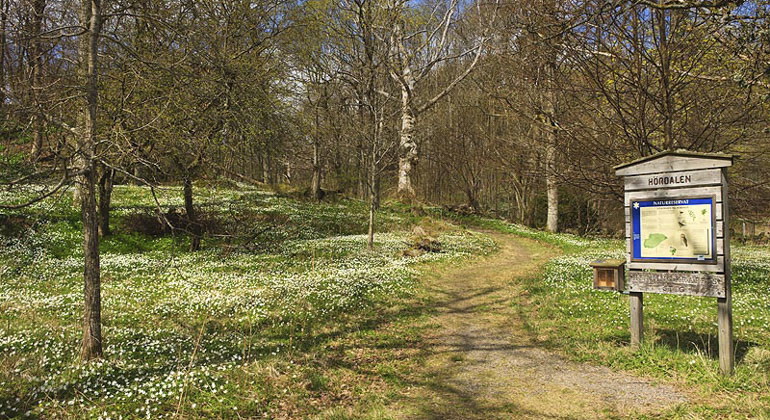
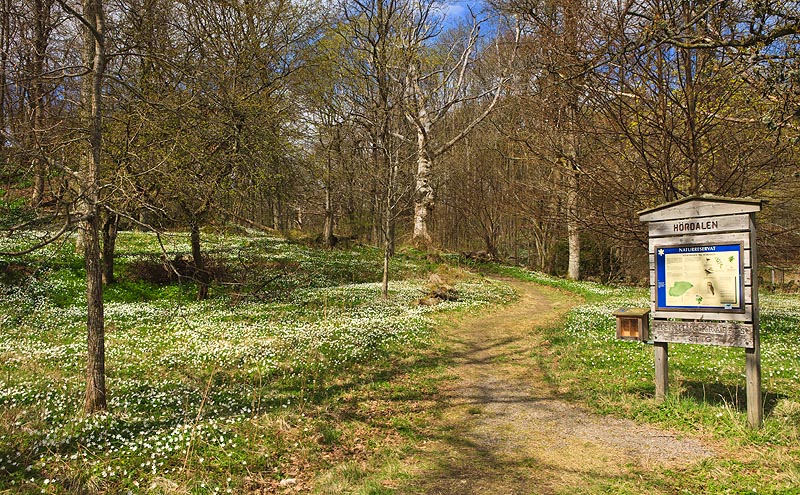
reservtasskylt vid entré -
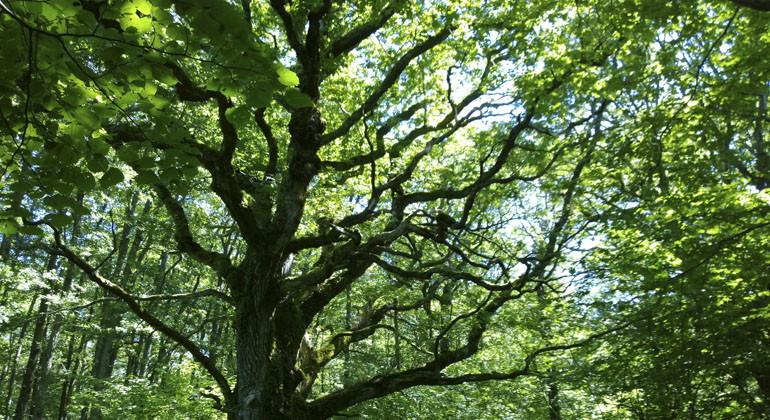
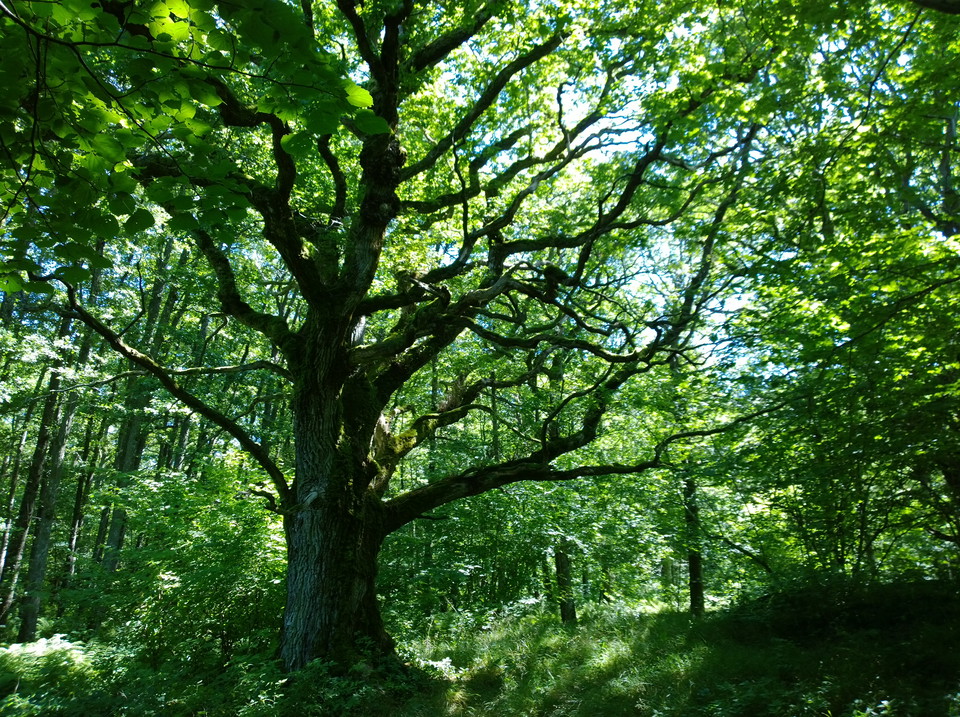
stort grönskande träd -
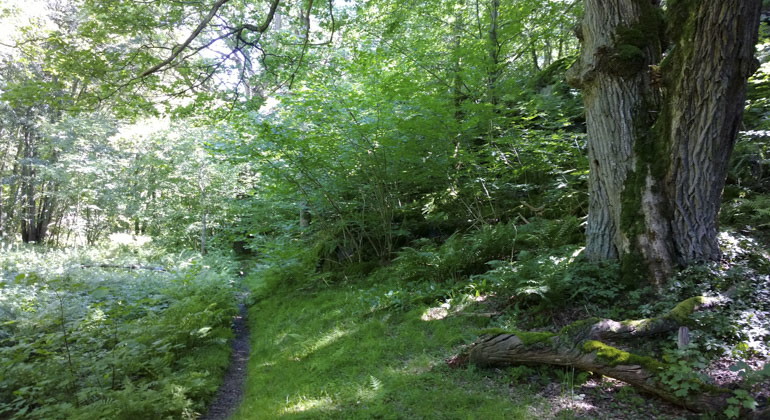
trädstam, rötter och gräs -
-
Hördalen, Naturreservat
- Naturreservat
- Amt: Hallands län
Handlinger
Beskrivelse
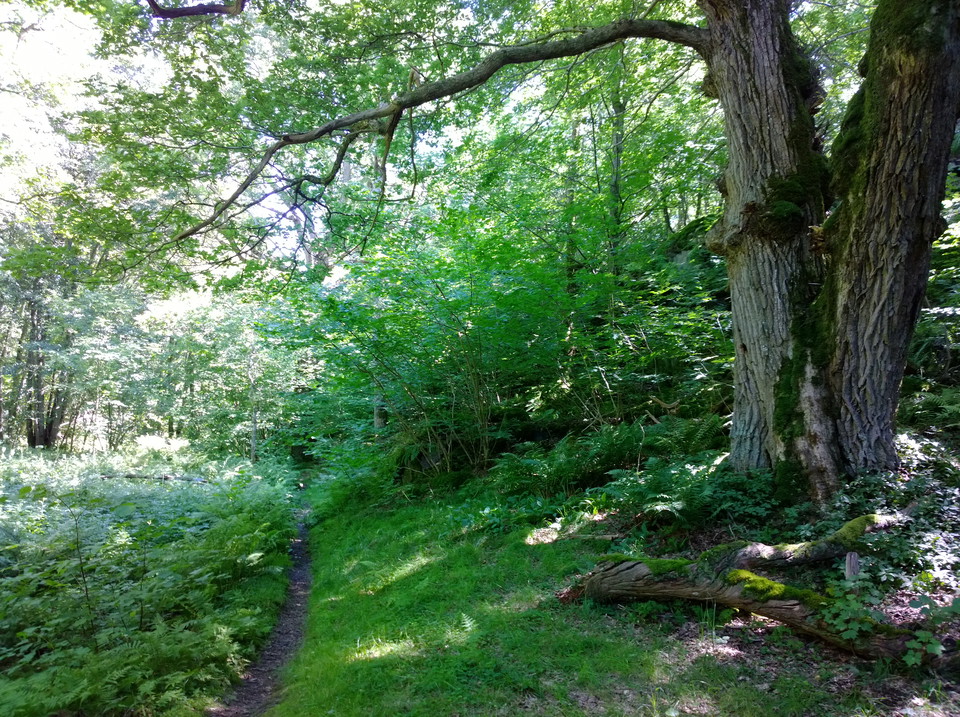
Hördalen is an exceptionally beautiful small valley southeast of Särö. The valley is just under a kilometer long and at its widest a couple of hundred meters. In the spring, you can walk through a sea of anemones to the sounds of chirping birds.
In the valley there are oaks with huge crowns and rough bark that are several hundred years old. Up on the lean rocky knolls, the mountain oak forms scrub forests. It is characterized by late-growing, crooked and short trees. Maples and lime trees also grow on the northern slope of the mountain. Some of the oaks in Hördalen look damaged. They have hollows at the base or on the trunk where branches once stuck out. The damage has nothing to do with any disease, but is a natural process caused by fungi and insects eroding the oak's interior over time.
Endangered species live here
A large number of threatened and rare species make their home in the valley. One of the more unusual is the signal species old oak lichen, a chalky white lichen whose name says something about where it lives. Two other of Hördalen's rarer guests are the red-listed ticks, the teardrop tick and the oak leaf tick, the latter of which has only been found in a couple of other places in the country. The teardrop tick is a fungus that grows at the base of mainly old and large oak trees. It gets its name from the fact that when it grows it secretes brown liquid droplets that resemble tears. Other threatened species here include the bird's foot moss, saffron finger fungus, sand lizard and the yellow-legged comb beetle.
Many herbs bloom in spring
Parts of the valley used to be a meadow where hay was cut and animals grazed. The open conditions allowed the oaks to grow large and mighty. Thanks to the sunlight reaching the ground in the sparse forest, the herb flora is rich and in the spring you will find wood anemone, cowslip, wood sorrel and lily of the valley in the reserve. In the spring, the air is filled with birdsong from warblers, blackcaps and robins. Starlings, woodpeckers and tawny owls can be seen in the tree nests.
The golden plover colors the surroundings
In the central part of the valley there is an alder marsh. An alder bog is a special type of swamp forest, which is occasionally under water. At the beginning of the summer, the yellow cabbage lime is in full bloom next to the well-developed root bases of the alders. The marsh and its vicinity are also home to ferns, yellow sword lily, common ragweed, brook rush and goldenrod. With its shimmering yellow seeds, the goldenrod adds color to its surroundings. It is a flower with a real golden sheen!
Stamp in the reserve
In some of our most popular reserves, you can also collect a nice stamp when you visit the reserve. You stamp either directly in your guidebook or on your own paper/book. In Hördalen, the stamp is found along the loop that runs in the reserve.
Folder
Folder about Hördalen Link to another website, opens in new window (PDF)
Aktiviteter og faciliteter
- Naturreservat
Fakta
Dominant habitat type: Broadleaf forest
Municipality: Kungsbacka
Area: 31 hectares
Protected since: 1971
Owner: West Coast Foundation
Trustees: West Coast Foundation
Rutevejledning
Hördalen is located in Kungsbacka municipality, midway between Vallda sand island and the southern part of Sandsjöbacka.Bicycle: Kattegattleden goes past the reserve and the hiking trail.Public transport: Stop "Hamravägen" is located at the parking lot of Hamra golf course.Car: Drive road 158 from Kungsbacka towards Särö. Barely two kilometers after Vallda, there are signs for Hamra golf course on the left where there is parking. The hiking trail to the reserve starts from the golf course. GPS (WGS84): Lat N 57° 29' 37" Lon E 11° 59' 9" (parking lot at Hamra golf course).
Regler
To protect the nature reserve, the County Administrative Board has decided on special regulations, including those that you as a visitor to the area must follow and respect.
In addition to what applies under other legislation, it is forbidden to:
- destroy or damage fixed natural objects or surface formations,
- picking or digging up herbs, deliberately disturbing wildlife, for example by taking close-up photographs of nesting sites,
- camping or putting up a caravan
- lighting fires
- riding, driving motorized vehicles or other means of transport
- damaging fences or other structures, and
- use a radio, gramophone, tape recorder or the like in a disruptive manner
- keeping a dog unleashed.
Kontakt
E-mailadresse
Kontakta oss om du har frågor
Organisationens logotype

Jeg har været her 5


Jeg vil gerne derhen 6



Spørgsmål og svar
Stil et spørgsmål til andre Naturkartan-brugere.
Anmeldelser
0 anmeldelser
- 5 :
- 4 :
- 3 :
- 2 :
- 1 :
Brugernes billeder
Der er endnu ingen brugerbilleder. Vær den første til at dele et!