
Lilla Karlsö, Naturreservat
- Naturreservat
- Amt: Gotlands län
Handlinger
Beskrivelse
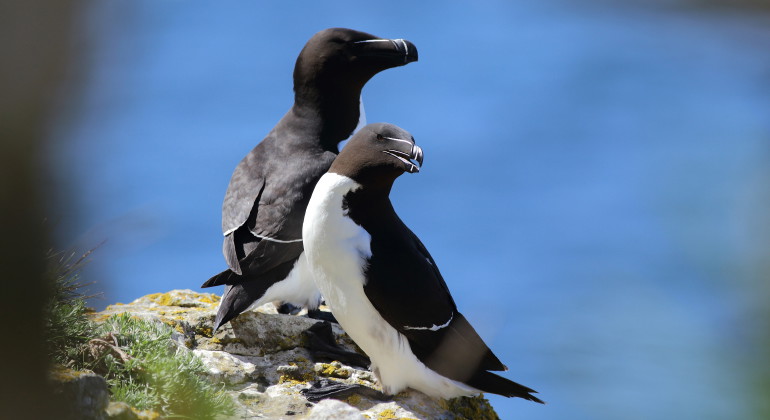
You might think that Lilla Karlsö is just a smaller version of the neighboring island Stora Karlsö, but this is not the case at all. As on Storön, there are high cliffs with thousands of nesting auks, but the island has its own character, is perceived as more barren and has almost no buildings.
Lilla Karlsö is an island with bird mountains and sheep-grazed limestone heaths. The island has an area of about 1.5 square kilometers and consists of an almost circular plateau, which is slightly arched and reaches a maximum height of 66 meters above sea level. To the north and south, the plateau is surrounded by low plains, and to the east and west it is bounded by steep cliffs. The northern plain is a raucous landscape, while the southern plain is flat and covered by a series of embankments created when the sea level was higher than it is today.
Sheep have grazed on Lilla Karlsö for thousands of years, and the island has a distinctive grazing landscape. Areas with relatively thick, rich soil cover alternate with alvar-like rocky areas. Old, coarse and gnarled deciduous trees such as ash, elm, oak, finnoxel and oxel grow in the southern ravines. The sheep that now graze on the island are of the Gutefår breed, where both rams and ewes have horns.
The intensive sheep grazing has given the vegetation a heathy character,
dominated by narrow-leaved grasses such as sheep's fescue, with a significant amount of rice. More than 360 species of vascular plants have been found on the island. Characteristic species include lesser celandine, lesser celandine, wild larkspur, tulkwort, sundew, lesser celandine, lesser celandine, creeping thyme, spearmint and creeping thistle. There are also several unusual plants on the island, such as deer's tongue, heart thistle, Gotland nun's wort, clove, wreath borer, blue-flowered make-up root, nettle, honey flower and carnation lettuce.
More than 70 species of birds nest on the island. Thousands of guillemots, razorbills and cormorants live on the slopes of Öster- and Västerberget. Other common breeding birds are the black-headed gull, oystercatcher, herring gull, herring gull, common tern and little tern. Eider nests all over the island, and in the cliffs, blackbirds, great and lesser black-backed gulls, and mallards. A colony of black-headed gulls breeds in the marshes, as well as several species of ducks, including shoveler and gadwall. The beaches are home to waders such as oystercatchers, redshanks, oystercatchers, lapwings and curlews. Lapwing nests in unusually large numbers for Gotland conditions. House martins and swifts nest in the cliffs. Wood pigeons live in the old hollow trees.
Gray seals regularly stay on the island's shores. There are about a hundred snakes on the island. These are characterized by a strongly varying coloring, and many are completely black. The snakes feed mainly on fish.
There have probably never been permanent residents on Lilla Karlsö. Instead, the island has been used seasonally for fishing, seal hunting and sheep grazing. There are several graves on the island from the Bronze Age, Iron Age and Middle Ages. On Norderslätt there are several foundations of boathouses from the 18th century.
Aktiviteter og faciliteter
- Naturreservat
Fakta
Year of protection: 1955
Parish: Eksta
Characteristics: Bird mountain, limestone heath
Area: 926 hectares of which 158 hectares are land and 768 hectares water
Landowner: Swedish Society for Nature Conservation
Administrator: County Administrative Board of Gotland
Type of protection: Nature reserve, Natura 2000
Regler
For everyone's well-being and to maintain the reserve's natural and cultural values, it is important that all visitors show consideration. In addition to the right of public access, it is not allowed to:
- during the period 1/2-31/8 enter or stay in the parts of the nature reserve covered by bird protection
- during the period 1/3-31/8 stay on the island without permission from the county administrative board or the supervisor appointed by the county administrative board for the reserve. During the period 1/9-28/2, the public is entitled to stay on the island after written notification. Visitors must make such notification immediately after landing at the pier on the eastern side of the island.
- land elsewhere than at the jetty on the eastern side of the island without the permission of the county administrative board or the supervisor appointed by the county administrative board for the reserve
- board sailing, water skiing or driving a jet ski
- drive a motorized vehicle
- fly over the reserve with an aircraft in a disruptive manner or to land with an aircraft
- fishing with anything other than hand gear or fishing from the shore
- bringing ashore a dog, cat or other pet
- picking or digging up plants or mushrooms
- collecting insects, spiders, shells or snails
- catching or killing amphibians or reptiles
- capture birds for ringing without the permission of the county administrative board
- collect fossils or move or remove stones, boulders or floating driftwood
- dig, hack, chisel, carve, drill or otherwise damage land, solid rock, boulders or stones
- put up a board, sign, poster or similar device
- build an open fire
- camping
- use a radio, tape recorder or musical instrument in a disruptive manner outdoors
- conduct tourist traffic to the island
Kontakt
E-mailadresse
Länsstyrelsen i Gotlands läns naturvårdsförvaltning
Organisationens logotype
Jeg har været her
Jeg vil gerne derhen 2

Spørgsmål og svar
Stil et spørgsmål til andre Naturkartan-brugere.
Anmeldelser
0 anmeldelser
- 5 :
- 4 :
- 3 :
- 2 :
- 1 :
Brugernes billeder
Der er endnu ingen brugerbilleder. Vær den første til at dele et!