
Fardume slott
- Forhistorisk/kulturarv
- Landsdel: Gotlands län
- 6969.05 km fra dig
Handlinger
Beskrivelse
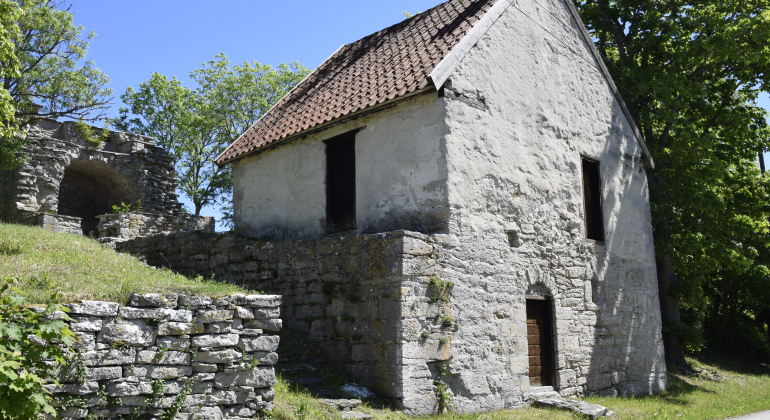
The word 'castle' often brings to mind palatial, royal buildings. Here on Gotland we use the word a little differently, often as an ancient castle, here it is the two medieval houses in the picture that are Fardume Castle.
There is a long history of human activity on the site, of which the various remains are traces. The name Fardume Castle includes Sören Norrby's cellar and the Mint Tower.
The property is located near the Fardume swamp and, due to its location on a hill, has a good view of both the swamp and the land in between.
Sören Norrby's cellar is located next to the road between Valleviken and Risungs. The road can be traced far back in time and along the road there are many remains from both the Bronze and Iron Ages. Near the property there are limestone quarries and lime kilns. There are also smaller limestone quarries on the property and the remains of a possible lime kiln. For a long time, the lime industry was of great importance in northern Gotland alongside agriculture.
Sören Norrby's cellar
The building dates to the 13th century. The name Sören Norrby's cellar can be traced back to the Danish lord of the same name who ruled Gotland between 1517 and 1525. The house on top of the medieval cellar is believed to have been added in its current volume during the 18th century. The superstructure used to have a hipped roof but was given its current tiled roof after a restoration in the 1940s.
The house type can be traced to the type of Gotland residential buildings that were common on the island in the Middle Ages, with the exception that this building is located on a sharp slope, which changes the traditional distribution of rooms. The history reflected in the Gotlandic residential buildings is that the Gotlandic farmers were not only involved in agriculture but also in other industries such as trade.
Stone houses were therefore built partly for the storage of goods. The building craftsmanship was lavish, with arched windows and doors in a building technique similar to that used in churches.
The lower floor of Sören Norrby's cellar has been used as a cellar. There used to be an external staircase on the gable to the second floor, where the front room and living room were located. The first floor was located directly above the basement and the living room followed to the northwest. There is no evidence of an internal connection between these rooms.
The coin tower
Behind Sören Norrby's cellar are the remains of a supposed castle, the so-called Mynttornet. It is believed to be a fortification building that today rises to a height of three storeys. The Mint Tower dates back to the 12th century and was probably originally up to five storeys high. In later times, its defensive function was changed to that of a magazine. At this stage, a new opening was also added to the building.
The mill ruin
There has probably been a mill on the site since the later part of the 17th century. The mill ruin that exists today on the site is not so old, however, but was probably built sometime around the turn of the century 1700/1800. It was probably used until sometime around the First or Second World War. The mill ruin is of the cap mill type, with a round stone base in two floors.
Aktiviteter og faciliteter
- Forhistorisk/kulturarv
Fakta
Socks: rod
Character: Medieval ruin
Owner: Föreningen Gotlands fornvänner
Type of protection: Listed building, ancient monument
Regler
Sören Norrby's cellar is protected as a listed building under Chapter 3 of the Cultural Environment Act (1988:950).
The ruin, the coin tower, is protected as an ancient monument according to the Cultural Environment Act (1988:950) Chapter 2.
According to the Cultural Environment Act, permission from the County Administrative Board is required to disturb, remove, excavate, cover, alter or damage an ancient monument.
Remember that a land area around each ancient monument is also protected. Even a newly discovered ancient monument has immediate protection.
If you are unsure how large the protected area is, you can contact the County Administrative Board.
The building is protected as a listed building under Chapter 3 of the Cultural Environment Act
Kontakt
E-mailadresse
Länsstyrelsen i Gotlands läns naturvårdsförvaltning
Organisationens logo
Jeg har været her
Jeg vil gerne derhen
Spørgsmål og svar
Stil et spørgsmål til andre Naturkartan-brugere.
Anmeldelser
0 anmeldelser
- 5 :
- 4 :
- 3 :
- 2 :
- 1 :
Brugernes billeder
Der er endnu ingen brugerbilleder. Vær den første til at dele et!