
-
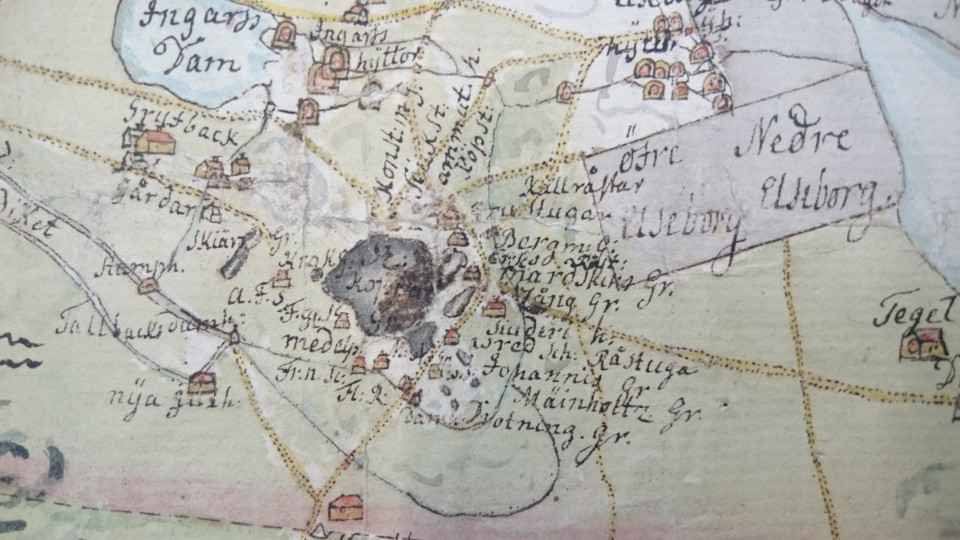
Detalj av karta år 1754 Riksarkivet -
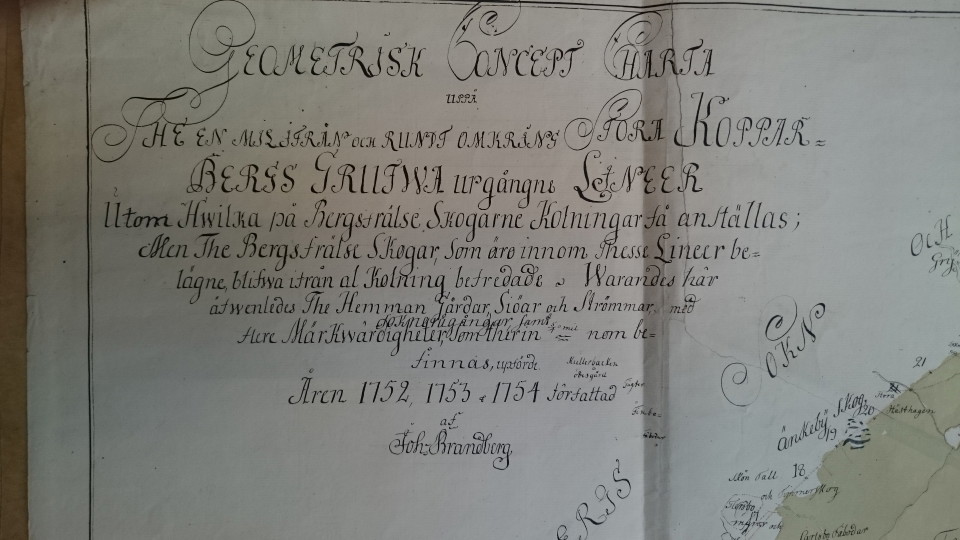
-
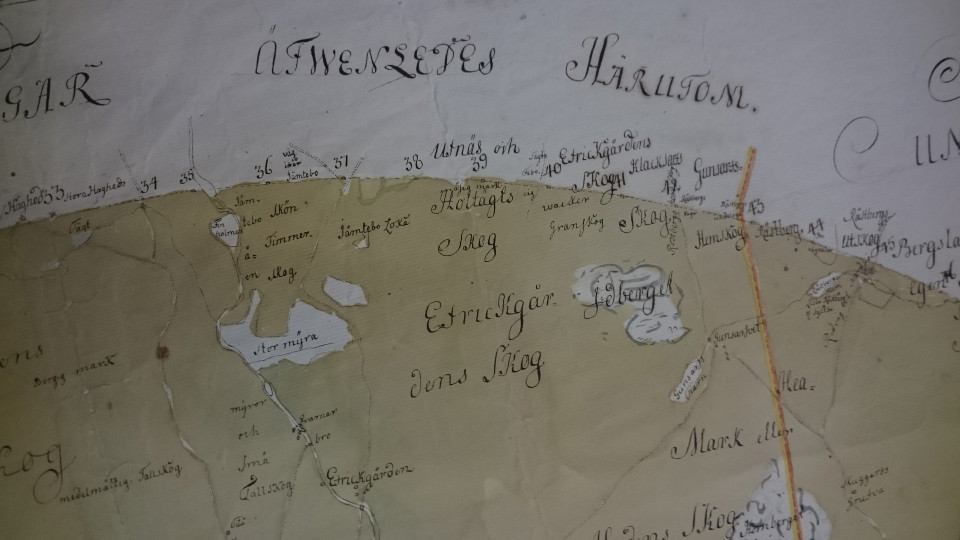
Konceptkarta 1754 röse 34-45 -
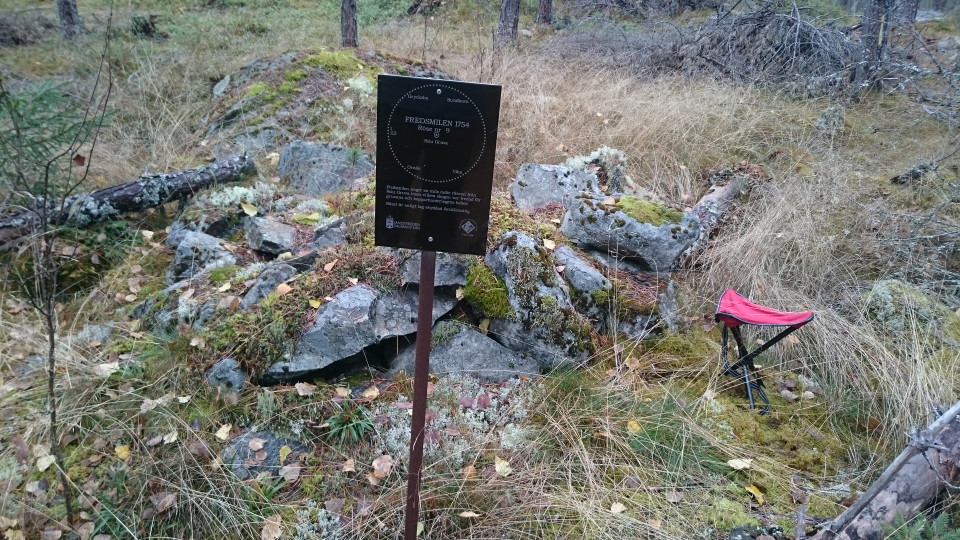
Röse med skylt idag
Fredsmilen Historia
- Kulturmiljø
- Amt: Dalarnas län
Handlinger
Beskrivelse
What is the Peace Mile?
A circle around the Falu mine
In 1754 - about 270 years ago - 112 points were marked with cairns (in some cases with stakes or otherwise) on the periphery of a circle with the Falu mine in the center and with a radius of 1 mile (one old Swedish mile = 10,689 m). In modern peace mile inventories, it turns out that the actual radius from a calculated center point is on average 10900 m. The explanation for this is probably measurement errors due to worn measurement chains.
Forest utilization regulated
Fredsmilen was part of the "regulatory framework" for the production of various forest products for the needs of mining and copper production that was established in the 16th, 17th and 18th centuries.
The Falun mine and copper production were extremely dependent on an abundant supply of forest products, and during the 17th century boom, the consumption of firewood and charcoal in Falun reached unprecedented proportions in the country. This led to heavy felling pressure on the forests in the vicinity of the mine, while at the same time the timber harvesting area was extended to cover large parts of Dalarna and the parishes in which round timber was to be produced and where charcoal was to be produced for the copper smelters were determined.
Although it was not until the 1750s that Fredsmilen was physically marked out in the terrain around Falu mine, and then linked to a ban on charcoal production on the miners' land within the ring, restrictions on felling within Fredsmilen had been issued long before that.
- In 1572, Upper Dalarna's farmers were forbidden to cut tax wood in the miners' forests within a mile of the mine without the landowners' consent. This quickly led to loud protests and, as late as 1620, farmers from Rättvik were complaining that they might have to cut their wood 'here at home in Dalarna' because the unfriendly miners would not allow them to use their forests.
- In 1607, Charles IX issued his oft-quoted ban on felling forests within a mile of the mine
New rules for forest exploitation
During the 18th century, total wood consumption gradually decreased and it became natural to question some of the old restrictions on the right to harvest and charcoal in the vicinity of the mine.
It is in this context that the creation of Fredsmilen should be seen. In 1752, the Bergsrätten (Mining Court) requested free coal mining rights on all the Bergfrälseskogen forests that lay more than a mile from the mine. Prior to this, there had been a ban on coal mining in all Bergfrälseskogs. The Bergskollegiet had reservations about why Kungl. Maj:t first increased the radius to 1 ¼ mile (23/5 1752) but later returned (16/1 1754) to 1 mile.
Markings on the ground to confirm the new rules
Probably to prevent any possible disputes in connection with the application of the new, relaxed rules, it was also decided that Fredsmilen should be clearly marked in the terrain and Johan Brandberg was commissioned to implement this. The name "Fredsmilen" then stood for the boundary within which the mountain salvation forests would still be "protected" for free charcoal burning.
An extensive surveying assignment
The surveyor Johan Brandberg, who was responsible for the project, had been commissioned by Kungl. Maj:t's Bergskollegium already in 1752 and had during the past two years staked and measured 32 "radii with mile points" (counted from the mine) in the circle (we call these Radierösen). In 1754 he calculated and measured the locations of basically as many mile points further on the circle periphery (we call these Mellanrösen) starting from the first 32. In this way a "64-corner" was obtained where Brandberg and his assistants marked the corners with cairns or stones, where possible. (Some milepoints ended up in Lake Runn and could of course not be marked with cairns). On mountain fief land, i.e. land owned by the mountain men, the marking was done with large square cairns - on other land - tax forest or "peasant forest" - the marking normally consisted of stones that were described in terms of size and shape.
In the middle of the corner points, he measured out places for "intermediate cairns" (Brandberg's term, we call these Kordarösen) in the Bergfrälseskogen, and streets were also cut between the cairns. Normally, no "intermediate markers" were placed in the treasure forest, and the boundary line was only marked with markers on the trees. A total of 112 corner points and intermediate markers were measured and described in detail in a document that has survived.
The circle thus measured and marked became known as the 'Peace Mile'. Other names, such as the 'coal line' and the 'seven-mile ring', have also been used.
Unknown to most people
The Peace Mile has been surprisingly unknown among the common man in our days. It is mainly among museum people and enthusiasts with ties to the relevant local history societies that they have known about it and kept track of the known cairns.
Signs at known cairns
The Dalarna County Administrative Board has paid for simple but clear and permanent signs to be put up in the terrain next to rediscovered cairns and stones. This will hopefully increase awareness of and interest in the Peace Mile, while helping to prevent further unnecessary damage to the cairns.
The Peace Mile in the World Heritage House
In the entrance hall of the World Heritage House (www.varldsarvetfalun.se) at the Falu mine, a large map (about 5 m in diameter) of the World Heritage areas has been placed as a mosaic in the floor and this map has been limited by the Peace Mile and with copper pieces as cairn markers.
As a "forest history" phenomenon linked to the Falu mine and the World Heritage Site, the Peace Mile should today be an exciting and educational attraction. Many people have asked for map material to make it easier for those interested to find the cairns themselves. In addition, there are still some cairns that have not yet been found and are waiting to be discovered!
Aktiviteter og faciliteter
- Kulturmiljø
Fakta
The accuracy of measured coordinates is about 3 meters.
In a hypothetical position, the cairn should have been within a radius of 10 meters when there are surrounding cairns. If there are no surrounding cairns, the uncertainty, mainly in the distance to the mine, is greater.
For conversion from cubits to meters, the factor 0.6 can be used (multiply by 0.6). The standard conversion is 0.5938 but due to measurement errors and worn measurement chains, the real distances are obtained with factors between 0.60 and 0.61.
The quarts used as a measure refer to 1/4th of a cubit (15 cm).
The peace mile circle drawn shows the distance from the center of the mine, with a radius of 10900 meters, the average radius of all the cairns. In reality, the cairns are located on the periphery of a 64-cornered circle influenced by 18th-century measurement accuracy and, to some extent, geographical conditions.
The center of the mine was located in 1754 in the vicinity of Fredrik's shaft, today a bit out in the southern part of Stöten.
The description of each cairn is a transcript from the surveyor Johan Brandberg's protocol from 1754.
Click on the cairn mark in the map for information about individual cairns.
At present there are 112 cairns:
83 are definitely or reasonably definitely determined.
25 have not been found or have disappeared.
4 in lake and therefore not marked with cairn.
Rutevejledning
De allra flesta rösena ligger i helt obanad terräng, inga stigar sammanbinder i dagsläget rösena. På vissa håll är skogen nästan ogenomtränglig, ibland måste man passera hyggen och röjningar med besvärlig mark och skogsrester. Skogsbilvägar kan på vissa ställen underlätta framkomligheten. Många skogsbilvägar har stängda bommar.
Det är med andra ord, inte lätt att ta sig runt mellan rösena, men man finner också vacker natur och trakter man normalt inte hittar till. Hela cirkelns omkrets är nästan 7 mil, fågelvägen, bitvis fiskvägen.
För vandring kan det vara lämpligt att dela upp cirkeln i dagsetapper, tex
112 (Smedsbo) till 22 (Grycksbo)
25 (Grycksbo) till 45 (Rostberg, Envikensvägen)
46 (Rostberg) via 50 (Sundborn) till 62 (Danholn)
66 (Danholn, Stensarvet) via 71 (E16) till 75 (Staberg)
79 (Kniva) till 84 (Färnviken)
101 (Fågelmyra) till 109 (Brusala)
eller swim-run, 87 (Vika kyrka) via Fornäs Udde, Sunnanö, Ösjön till 100 (Ornäs).
Kontakt
E-mailadresse
Kontaktcenter Falu kommun
Organisationens logotype

Jeg har været her
Jeg vil gerne derhen 4

Spørgsmål og svar
Stil et spørgsmål til andre Naturkartan-brugere.
Anmeldelser
0 anmeldelser
- 5 :
- 4 :
- 3 :
- 2 :
- 1 :
Brugernes billeder
Der er endnu ingen brugerbilleder. Vær den første til at dele et!