
-
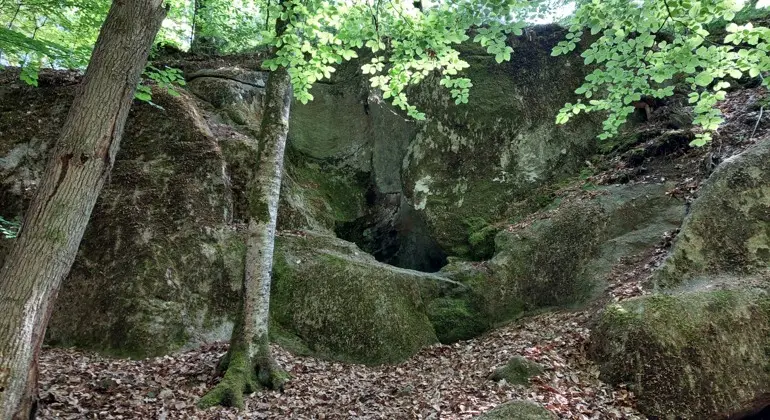
Jättegryta med spräckt sidovägg. Fotograf: E. Wallsten/Länsstyrelsen Blekinge
Tararps jättegrytor, Naturreservat
- Naturreservat
- Amt: Blekinge län
Handlinger
Beskrivelse
Welcome to visit a giant pot area from the Ice Age, with about ten giant pots, in a mountainous oak, pine and beech forest area. The northern parts of the reserve are dominated by deciduous swamp forests and open marshes.
Giant pot with a cracked side wall. Photographer: E. Wallsten/Länsstyrelsen
Blekinge
Outdoor life and accessibility
The nature reserve is easily accessible, with a small visitor parking lot along Tararpsvägen. From the parking lot you can via a dirt road and a marked path get around the giant pot area in the southern part of the reserve. The trail is just over 600 meters long. There is a picnic area with tables and benches on a rocky outcrop adjacent to the trail. The northern parts of the reserve, which are dominated by wetlands, have no paths.
There are no accessibility adaptations within the nature reserve. The dirt road in the south is relatively level, but hilly. The marked path leading through the giant potato area is hilly in places, passing through woodland and over rocky outcrops.
Istida giant potholes
In the southern parts of the nature reserve there are about ten large and small potholes in the bedrock. During the last two million years of glaciation, small cavities and irregularities in the bedrock have been excavated and enlarged by grinding rotating blocks, stones and gravel in flowing glacial river water. However, some of the original smaller pits may have been formed already during the Mesozoic geological era (252-66 million years ago), when the climate was tropically humid here and small weathering pits were formed by deep weathering of the bedrock. Oceans then moved in over the area and sedimentary sand, clay and limestone rocks protected the weathering pits for millions of years before the area became land again and the sedimentary rocks were worn away. The weathering pits then became visible again, and ice-rafted rock material of different sizes could get stuck in them in a swirling, rotating dance.
Tararp's giant pot field was designated a natural monument in 1966, to protect the pot formations. The larger of the nature reserve's giant pots are up to a couple of meters in diameter and about the same depth. Some of the smaller pots are surprisingly deep, relative to their diameter. One of the larger pots has cracked, so parts of the wall have disappeared and you can see what it looks like in cross-section from the side.
Throughout history, giant pots have captured people's imagination and there is a great deal of folklore associated with them. Coins and other offerings have been found in giant pots and they got their name, giant pots, from the belief that giants used to cook their food in the pits.
Forests on ancient outcrops
The nature reserve is located in the old outlying areas of Tararp village. The southern, mountainous parts of the reserve are characterized by oak, pine and beech-dominated forests and open rocky areas. The forests are largely multi-layered and diverse, with stand ages of up to 150 years. These lands have probably been forested for a very long time. A map from 1781 indicates that there was then 'Stor Boke Skog' around here.
The northern parts of the nature reserve are dominated by deciduous swamp forests and open marshlands, with elements of willow scrub. The field layer is abundant with missne. The wetland is affected by a drainage ditch to the south, down through the giant potato area.
The dirt road, which runs east-west through the southern parts of the reserve and then turns north to the east of the nature reserve, is partly a hollow road. It is shown on the map from 1781 and is called "Somar Wägen" (summer road). West of the wetland, where Tararpsvägen runs today, "Winter Wägen" ran north. The wetland's inflow from the north and original runoff to the west probably made it too wet to use the western road, the winter road, when the ground was not frozen. The summer road and the winter road joined a bit north of the nature reserve. Other cultural-historical remains within the reserve include a stone bridge, stone walls and fossil cairns on previously cultivated areas.
Aktiviteter og faciliteter
- Naturreservat
Fakta
Protection year: 2025
Municipality: Karlshamn
Type of environment: Forest land, Wetland
Characteristics: Giant pots, Deciduous and pine forest, Deciduous swamp forest, Swamp, Outdoor life, Cultural history
Area: Total 6.0 hectares, of which 6.0 hectares is land
Landowner: Private
Manager: Blekinge County Administrative Board
Type of protection: Nature reserve
Rutevejledning
The nature reserve is located just under five kilometers northeast of the center of Asarum. Follow Froarps bygata north for 1.5 kilometers, turn right onto Graneforsvägen and follow it for 300 meters, turn left onto Tararpsvägen and follow it for 2.5 kilometers north to the nature reserve's parking lot. Follow Froarps bygata north for 1.5 kilometers, turn right onto Graneforsvägen and follow it for 300 meters, turn left onto Tararpsvägen and follow it 2.5 kilometers north to the nature reserve's parking lot.The nearest bus stop is in Asarum, just under five kilometers southwest of the nature reserve. For directions to the nature reserve from Asarum, see description above under "Walk or cycle".
Regler
You are welcome to visit the nature reserve Tararp's giant pots, but be aware that it is not allowed to:
- drill, hack, blast, carve, dig, paint or otherwise damage soil, rock, earth, stone, natural objects or surface formation, or to relocate or remove soil or stone,
- damage a stone wall or other cultural heritage site
- unduly damaging or disturbing wildlife
- trapping or collecting plants, fungi or animals by destructive means, such as damaging or destroying habitats or substrates, or systematic collection by traps
- damaging living or dead, standing or lying trees and shrubs, removing or burning dead wood
- picking mosses, lichens or wood-boring fungi, other than what is reasonably necessary for species identification. However, edible fungi may be picked for personal use, provided that they are not protected
- digging up or pulling up plants
- planting, sowing or spreading plants, animals, fungi or other organisms
- drive motor vehicles other than in the reserve's parking lot
- ride a bicycle or horse other than on the existing road and parking lot
- camping or otherwise setting up camp
- park or set up motor vehicles, motorhomes, caravans, trailers or similar other than in the parking lot provided for the purpose. In the designated parking lot, parking or parking of vehicles may only take place between 04:00 and 23:00,
- light fires or use barbecues or similar.
Without permission from the county administrative board you may not either:
- carry out surveys involving sampling, marking, collecting, trapping, installing equipment or any other action that more than insignificantly affects the values that the reserve aims to protect and preserve,
- using the area for competitions, exercises, events or other organized activities that may disturb nature or the public's outdoor life,
- put up a board, poster, poster, sign, box, string, trail marking, inscription or similar device, other than temporarily (no more than one week) in connection with hunting or in connection with organized outdoor activities.
Kontakt
E-mailadresse
Länsstyrelsen Blekinge
Organisationens logotype

Jeg har været her
Jeg vil gerne derhen
Spørgsmål og svar
Stil et spørgsmål til andre Naturkartan-brugere.
Anmeldelser
0 anmeldelser
- 5 :
- 4 :
- 3 :
- 2 :
- 1 :
Brugernes billeder
Der er endnu ingen brugerbilleder. Vær den første til at dele et!