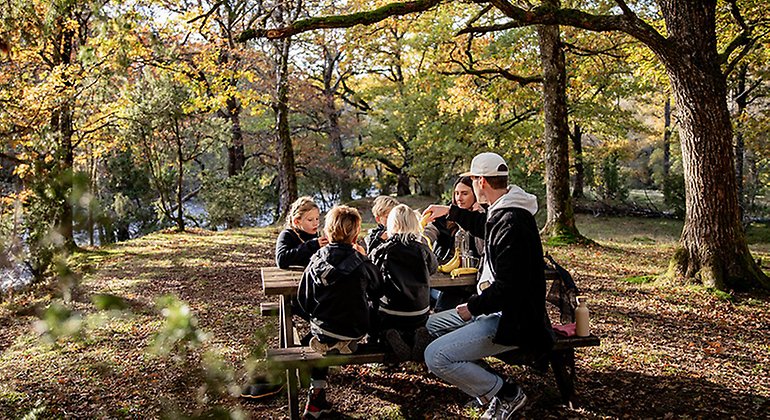
In a scenic valley just south of Ullared you will find Sumpafallen. An untouched stretch of Högvadsån, which is Ätrans' largest tributary, flows through the reserve. You can walk on footpaths along the rushing river and there is also a barbecue area near the parking lot.
Högvadsån forms four major rapids in the reserve. One of these, Sumpafallen, has given the reserve its name. Here and at the other falls, the roar of the rushing water can be deafening, but there are also areas of calm water where you can rest your ears for a while.
Trails in the reserve
A hiking trail of about two kilometers runs along the Högvadsån river and then follows the car road back to the parking lot. Next to the main path, at Sumpafallen itself, there is a prepared barbecue area. There is another barbecue area by the falls but it is not right next to the main path. Firewood is available but cannot be guaranteed.
Valuable watercourse
Högvadsån, together with Fylleån, is Halland's most valuable watercourse from a nature conservation point of view. There is a rich plant and animal life both above and below the surface. The fern safflower grows along shady parts of the riverbank. It is also called king fern because it can grow up to one and a half meters high. If you look under the surface of the water, you can see small insects living on the bottom with the naked eye. These can be the larvae of various dragonflies, beetles, mussels, worms and crustaceans. These animals are collectively known as benthic fauna. One insect that can be seen hunting between the rocks in the river is a relative of the water strider, the water strider. It is well adapted to the flowing water. Once it has caught a bug, it uses its proboscis to suck out the 'contents' of its prey.
Watching birds
In the greenery around the rapids, warblers and chaffinches sing every spring, and the common tern hangs out on the rocks in the water. Here you can also see kingfishers and woodcock and perhaps even the gray flycatcher where it keeps an eye out for flying insects from a branch.
Red-listed mussels
Another animal that lives in Högvadsån is the red-listed and protected river pearl mussel. By the early 2000s, the species had disappeared from a third of the places in Sweden where it was found in the early 1900s. There are several reasons for this dismal trend, but the main one is that many populations have not been able to rejuvenate. The mussel's reproduction is dependent on the fish, as its larvae live as parasites on the gills of the juveniles at an early stage, but without any harm to the fish. For the mussel, this is a smart way to move upstream and thus increase its distribution in the watercourse. In Högvadsån there are plenty of spawning salmon and trout and it has also been noted that the river pearl mussel has rejuvenated.
Unusual mosses
In addition to the rapids and falls of Högvadsån, the reserve also includes a variety of habitat types such as swamp forest, heath forest, pasture and mountain slopes. Much of the land is grazed, which gives the area an open character. In the westernmost part of the reserve there is an old oak forest and a lush alder forest. Here, spring flows emerge from the ground, which has allowed a very valuable flora to develop. In particular, you can find several unusual mosses such as brynia, rutlungmossa and dunmossa, but also the vascular plants brook burnet, bluebell, fern and the yellow shimmering goldenrod.
Folder