
-
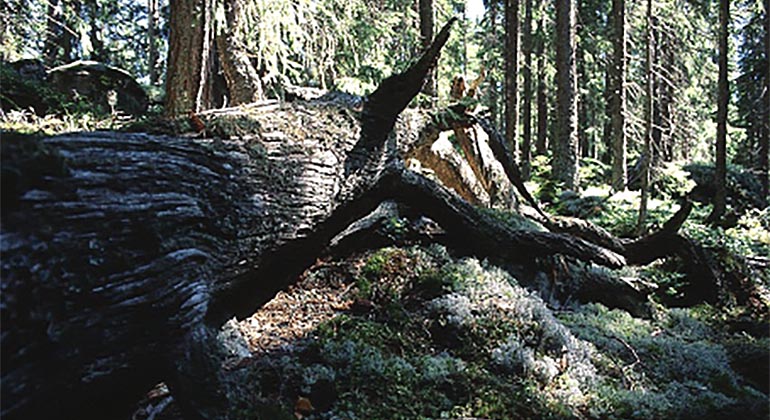
Liggande död tall, Södra Sandsjöåsen.
Foto: Kjell Store
Södra Sandsjöåsen, Naturreservat
- Naturreservat
- Amt: Örebro län
Handlinger
Beskrivelse
A visit to Södra Sandsjöåsen Nature Reserve is a bit like traveling back in time. The forest is clearly affected by fire and looks like the forests did in the past, when forest fires were a common phenomenon and modern forestry had not yet been born.
Foliage fire
Large parts of the forest on Södra Sandsjöåsen have grown up after a forest fire just over a hundred years ago. The result is a sparse coniferous forest with a large proportion of birch, aspen, willow and rowan - a so-called deciduous burn. Abundant deciduous trees are typical of fire-affected forests. The deciduous burn is most clearly developed on the western slope of the ridge and to the south. The oldest pines in the deciduous burn are around 250 years old and have survived several fires. There is clear fire damage on the trunks, known as fire sounds. The fire sounds are visible as cracks along the trunk, with exposed wood and carbon residues. There are also old stumps with soot marks from forest fires everywhere.
Unusual insects
There are several unusual insect species in the deciduous burn, including the northern flatworm, which lives under the bark of lying, dead tree trunks. Woodpeckers also benefit from the large amount of dead trees, where they can look for insect larvae. The woodpecker, great spotted woodpecker and three-toed woodpecker all nest in the reserve.
Fire fields
There is also a new small fire field in the reserve following a fire in the early 2000s. Immediately after a forest fire, many trees die from fire damage. They are quickly colonized by wood-boring fungi and insects. The large amount of deciduous trees that then grow up also benefits many species in the long term, especially when the trees start to age and die.
Plenty of beavers
Along Sandån, on the western border of the reserve, there are plenty of beavers that help to fell trees and create new dead tree trunks. On the mainland islands in Sandåmossarna there is an older coniferous forest with very old pines of around 350 years. These pines also bear traces of forest fires. In the past, forests burned regularly, perhaps every 40 years on average, and forestry was not practiced other than for domestic use of timber and firewood. The proportion of deciduous trees was therefore higher and there were plenty of dead tree trunks. In modern managed forests, however, there is a shortage of both coarse deciduous trees and dead trees, which means that many insects, fungi, mosses and lichens are threatened with extinction.
Accessibility
Södra Sandsjöåsen belongs to level 1 in the county administrative board's leveling of the county's nature reserves, which means that the reserve has a wilderness character and lacks outdoor recreation facilities.
Aktiviteter og faciliteter
- Naturreservat
Fakta
Municipality: Ljusnarsberg
Year established: 2007
Area: 188 hectares
Landowner: Swedish Environmental Protection Agency
Natura 2000: the area is part of the EU's network of protected nature, SE0240183 Södra Sandsjöåsen
Manager: County Administrative Board
Reserve creator: County Administrative Board
Rutevejledning
The nature reserve Södra Sandsjöåsen is located about 12 km northeast of Kopparberg and about 7.5 km northwest of Kloten.
Regler
In the nature reserve it is forbidden to:
- remove or damage dead trees or parts of trees
- make a fire
Kontakt
E-mailadresse
Organisationens logotype
Jeg har været her
Jeg vil gerne derhen
Spørgsmål og svar
Stil et spørgsmål til andre Naturkartan-brugere.
Anmeldelser
0 anmeldelser
- 5 :
- 4 :
- 3 :
- 2 :
- 1 :
Brugernes billeder
Der er endnu ingen brugerbilleder. Vær den første til at dele et!