
-
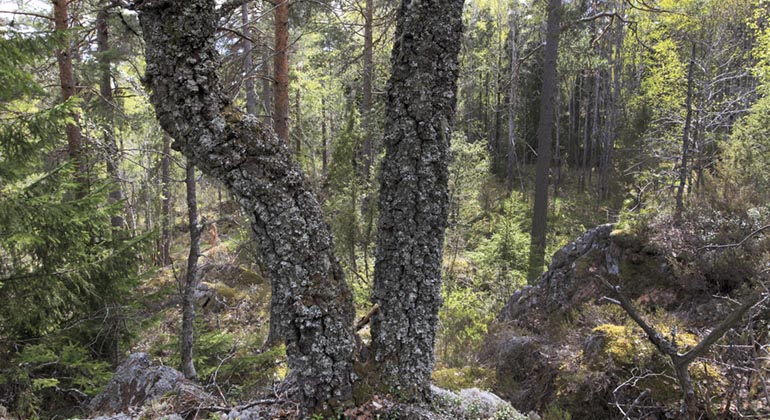
Kanterboda.
Foto: Kjell Store
Kanterboda, Naturreservat
- Naturreservat
- Amt: Örebro län
Handlinger
Beskrivelse
In Kanterboda nature reserve, nature is varied, from pine forest on rocky ground, spruce forest and coniferous forest mixed with deciduous trees, to swampy forest and marshland. Here you can find the yew, a small coniferous tree with red berries, which is unusual for our area. But beware, it is very poisonous! The calcareous bedrock allows many unusual plants to thrive in the area.
Lime provides a rich vegetation
The bedrock in the area consists partly of ancient limestone. Where there is limestone in the soil, there is usually a rich vegetation. In the nature reserve you will find many lime-loving plants. Olvion, tibast, witch hazel, soapwort and purple coneflower grow in the forest. The marshes are home to meadowsweet, fleabane, clubmoss and hartman's sedge. There is also a great wealth of fungi, such as the yellow sponge, scented sponge, fire sponge and yellow lamb's-tail. Among the rarer mosses, we can mention the common hair-grass moss and downy moss. Downy moss grows on really moist soil, preferably with shallow running water. The moving groundwater is collected in the largest rich marsh in the Närke region, Lannaforskärret, or as it is also known, Limbergskärret.
Memory of an ancient coastal landscape
The yew is a very shade-resistant shrub or small tree. It normally grows in coastal areas. And yes, there was a coast here, but more than 4000 years ago, when a precursor of today's Baltic Sea, the Littorina Sea, reached here. Biologists believe that the yew has been clinging here ever since. The yew is protected in many counties, including Örebro County. You can recognize it by its broad needles and red berries Everything on the yew is poisonous except the red flesh. But the seeds in the fruit are poisonous so don't taste them!
Limestone quarry and ancient castle
A disused limestone quarry is located west of Limberget. Lime was quarried here in the first half of the 20th century. The lime was transported via cable car down to Latorp station and from there on by rail to Degerfors ironworks. On the mountain south of the parking lot is Kanterboda skans. This ancient fortress was built sometime during the Iron Age (500 BC-1050 AD) and is one of Örebro County's 35 ancient fortresses. Why the castle was built we can only guess. Perhaps it was intended to serve as a refuge in times of turmoil, as a military garrison or some kind of cult site? The castle is bounded by cliffs, steep slopes and two stone ramparts. Once up on the ridge where the ancient castle is located, you have a good view of both Närkeslätten and Garphyttan.
Facts about ancient castles
Ancient castles fascinate people and there is something exciting and mysterious about them. What did they look like? What were they used for? Who used them? What era are they from?
Many ancient castles in Mälardalen
There are almost 2,000 ancient castles in the Nordic countries, and just over half of these are in Sweden. There are different types of ancient castles in different areas of Sweden, and the densest concentrations are in the Mälar region, along the west coast, in Östergötland and northern Småland. On Öland and Gotland there are also so-called lowland castles, which are quite different from those on the mainland.
The first researchers
Ancient castles have fascinated people over the centuries. The very first records of the country's ancient castles were made back in the 17th century. At that time, the main focus was on inventorying the location and appearance of castles. In the 1930s and onwards, the step was taken to start investigating the castles. The first archaeological investigations were carried out by archaeologists such as Ivar Schnell, Sten Anjou, Arthur Nordén and Mårten Stenberger.
What are the different types of castles?
Throughout history, ancient castles have been classified in different ways. The earliest is a pure description of what the ramparts look like. Are there one, two or three ramparts, and did they use rocky outcrops to build the castle? Then people started to take a little more interest in where the castles are located in nature. Are they built high up on a mountain? Or are they down in the lowlands? Then people started to take more interest in their function. Is it possible that people sought shelter in the castle? Are there many ancient monuments nearby? Is the site close to waterways where people could keep a close eye on who was traveling across the water? Have they been used as burial sites or are they more of religious importance? Was the castle perhaps used for living in?
What were the castles used for?
It was long believed that all ancient castles were places of refuge during troubled times, especially during the Migration Period (400-550 AD). At that time, there was no thought that the castles could have been built for reasons other than external threats, and this was long believed. Today there are several researchers who have new theories about these ancient castles. Calling all places ancient castles is not quite right, but they are often registered as ancient castles in the Swedish National Heritage Board's register of ancient monuments. Other names used are ramparts or enclosures. Many castles have been used as protection in times of unrest. Other castles have been used more for religious and cultic purposes. The sites are often located on high ground and have had a good view of the surroundings. It has been a natural vantage point used to look for signals in the landscape and from other ancient castles nearby. Whatever the reason for building the castles, they have been a significant feature of the landscape and have brought many people together.
Örebro County's ancient castles
There are 34 registered ancient castles in Örebro. Most of them are located at high altitude and overlook the surrounding areas. Some castles overlook several castles while others only look over to another castle. Many of the ancient castles are located in Kilsbergen along the edge and they all look out over Närkeslätten, for example Borgaresjö skansar, Tistaborg, Ullavi klint. They have not had the main contact with each other but have instead looked out over the plain and the ancient castles located on a band in the southern part of the plain area, for example Tarstaborg. These ancient castles in turn look back towards the ancient castles of Kilsbergen.
Aktiviteter og faciliteter
- Naturreservat
Fakta
Municipality: Örebro
Year established: 1980, expanded in 2011
Area: 48 hectares
Landowner: Swedish Environmental Protection Agency
Manager: County Administrative Board
Reserve creator: County Administrative Board
Rutevejledning
From Garphyttan, drive towards Lannafors. Take the exit towards Suttarboda. After a few hundred meters, see the sign on the left.
Regler
In the nature reserve it is forbidden to:
- bring an unleashed dog
- make a fire
- ride a horse
- drive a motorized vehicle
- break branches, cut down trees or otherwise damage living or dead trees and shrubs
- picking, digging up or otherwise damaging tree and shrub seedlings, flowers or other plants
- camping
- organize orientation checks or marked trails
- put up a board, poster, billboard, sign, inscription or similar
Kontakt
E-mailadresse
Organisationens logotype
Jeg har været her
Jeg vil gerne derhen
Spørgsmål og svar
Stil et spørgsmål til andre Naturkartan-brugere.
Anmeldelser
0 anmeldelser
- 5 :
- 4 :
- 3 :
- 2 :
- 1 :
Brugernes billeder
Der er endnu ingen brugerbilleder. Vær den første til at dele et!