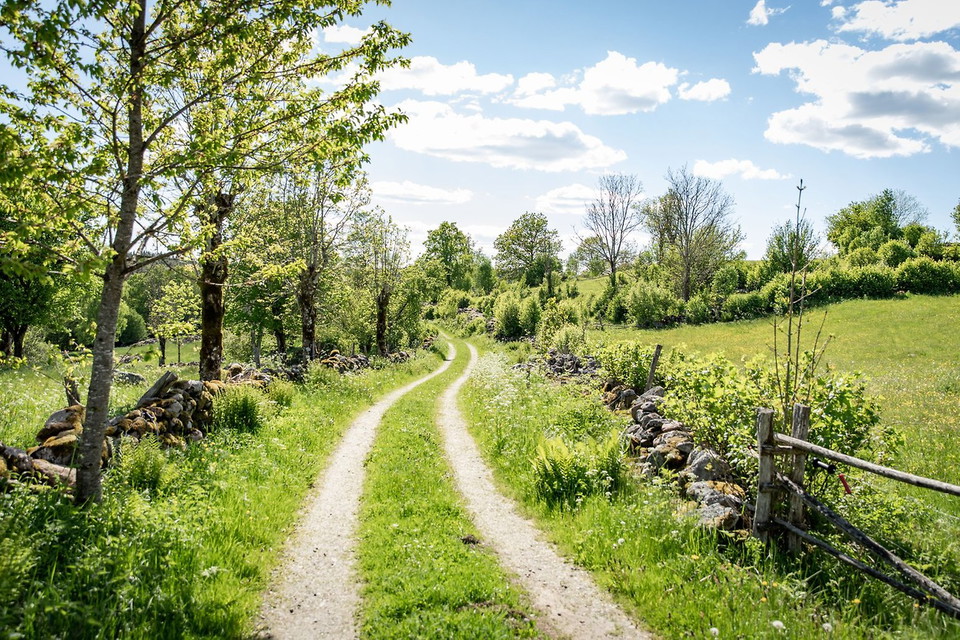
In the Yttra Berg nature reserve you will encounter a landscape that was common in the past, with pollarded trees, hay meadows, cultivation terraces and fencerows. The beauty of the area, the close contact with past times and the fine farm museum make Yttra Berg a popular destination for excursions.
Yttra Berg's agricultural landscape is largely preserved from the time before the 19th century shifts. With a map from 1830 in hand, you can still almost orient yourself in every detail!
Old farmland everywhere
Yttra Berg's beauty can largely be explained by its small scale. The landscape is both hilly and rocky, which has meant that generations of farmers have had to adapt to the terrain. They have cultivated on almost every dry surface available. The landscape is actually one of the county's (and the country's!) most rich in terms of ancient fields. The hay meadows and pastures contain an almost unbelievable number of cairns and terraces, which bear witness to the long-lasting hardships of farming.
Magnificent views and four nature trails
You can get a good overview of the surroundings if you go up to the hill Store Bergsåker, right next to the parking lot. The view from here is magnificent. To the northeast you can see Gällared's village and church, while to the south you can see the Ätrans valley. Alongside Store Bergsåker, a gravel road follows the curves of the terrain to the farm buildings in Yttra Berg.
With the help of the brochure "Nature and culture trails in Yttra Berg" you can walk four different trails that vary in length from 1-2.5 kilometers. During the walk, you will gain insight into the area's natural values and cultural history. The brochure is available at the information board in the parking lot and in the farm museum and in PDF format further down this page.
A small museum is located on the farm
The farm could be called the heart of Yttra Berg. Today you will find two farms with surrounding buildings. These are the Johansson brothers' farm and Aronsgården, which is owned by the Swedish Environmental Protection Agency and is part of the reserve. Aronsgården is the oldest, dating back to the 1600s. The unpainted barn, Sjöredsladan, was moved to Yttra Berg from Sjöred in Falkenberg in 1992. There is a small museum here with an exhibition on the history of the landscape, the reserve's animal and plant life and the activities of old-fashioned farming. In a listening studio you can hear stories from the area. The museum also has information about events in the reserve and a food court where you are welcome to enjoy your packed lunch. The museum is always open! Toilets are available at Aronsgården.
Strange trees
In the meadows and pastures there are gnarled trees with a strange appearance. The trees have acquired their shape by being pollarded, pruned, for generations. The pollarded trees used to be 'lush meadows in the air'. Cutting leaves and twigs provided an important supplement to the meadow's hay - about a third of the winter fodder came from the trees. Coppicing was carried out in late summer between mowing and harvesting. The leafy twigs were then tied together into sheaves and left to dry.
Mowing guild and arable farming
Within the reserve there is Store stockäng, which Gällareds hembygdsförening takes care of in the traditional way. During the spring, the meadow is cleaned of rice and leaves and in July the meadow is in full bloom. Buttercup, green-white night violet and hogweed are some of the meadow's flowers. At the end of July, the annual mowing guild is held with well-sharpened scythes and filled coffee baskets. The time is usually posted in the farm museum and you are welcome to participate. You are also welcome to visit the farm and see sowing and harvesting "the old way" with horse and self-binder.
Animals and plants
The flora is relatively rich in species due to two reasons. Firstly, the area has been maintained by grazing and mowing for a long time, and secondly, there is easily weathered greenstone in the area. Buttercup, hogweed, maidenhair fern and summer saxifrage are examples of species favored by grazing, while wood anemone, spring onions, ferns and desm buds are species that thrive on greenstone. The area is home to the hazel dormouse, which is unusual in Halland, as well as the bird species stonechat, nuthatch and lesser spotted woodpecker.
Podcast episode about old-fashioned agricultural landscape
Listen to the podcast episode about the old-fashioned agricultural landscape in Yttra Berg, Falkenberg municipality. The episode is produced with a grant from the County Administrative Board in Halland County.
Folder
Yttra Berg nature trails Link to another website